



Abstract
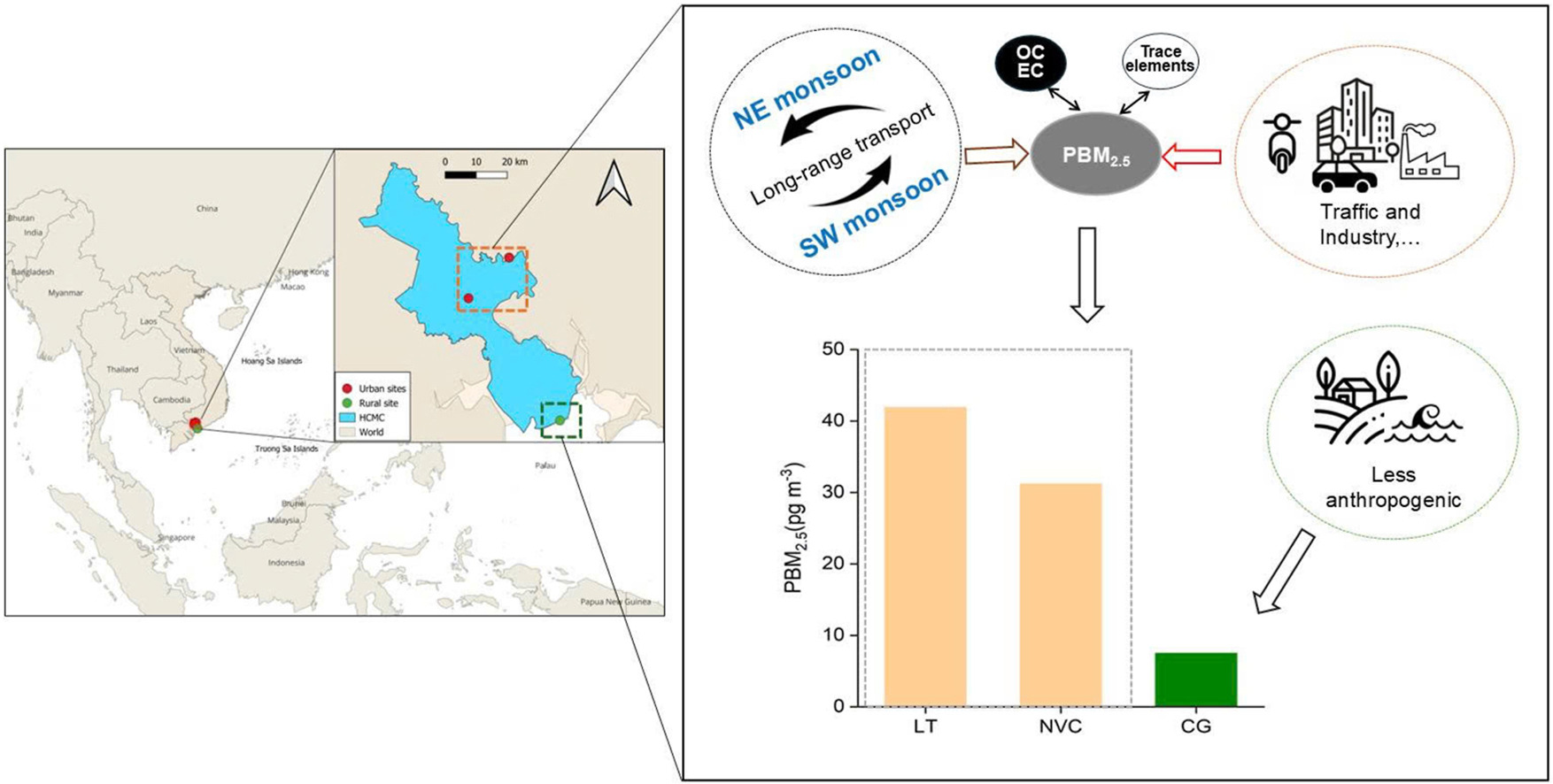
Fine particulate-bound mercury (PBM2.5) is being recognized as a public health and environmental issue owing to its high capacity to bioaccumulate and long-range transport. This study investigates PBM2.5 at two urban sites Nguyen Van Cu (NVC) and Linh Trung (LT) and one rural site Can Gio (CG) in Ho Chi Minh City (HCMC) to assess spatial distribution and sources. PBM2.5 levels were significantly higher at urban sites (NVC: 31.2 ± 13.9 pg m−3; LT: 41.9 ± 5.5 pg m−3) than at CG (7.5 ± 1.1 pg m−3). Cluster analysis indicated that air masses from the Northeast conveyed more PBM2.5, while marine-origin air masses are relatively lower in PBM2.5, highlighting atmospheric transport influences. A similar pattern was also identified by the PSCF (Potential Source Contribution Function) analysis, outlining monsoonal influences when Northeast monsoon significantly impacted PBM2.5 at NVC and LT. Correlation analysis and principal component analysis (PCA) suggested industrial and vehicular emissions as PBM2.5 primary sources at LT and diesel/gasoline emission as primary sources at NVC. At CG, lower PBM2.5 concentrations suggest a limited influence from anthropogenic activities, indicating spatial variability in PBM2.5 levels across HCMC. In addition, the health risk assessment, based on hazard quotient values below one, indicated that PBM2.5 concentrations were within permissible limits; however, children exhibited greater vulnerability compared to adults. These findings highlight the need for systematic monitoring in urban areas and contribute valuable insights into Hg pollution in Southeast Asia, supporting science-based air quality management.
Graphical abstract
Pham, T.D.H., Truong, M.T., Minh, T.H., Sheu, G.-R., Hien, T.T. and Nguyen, L.S.P. (2026) Atmospheric Pollution Research, 17(4), p. 102858.