



Abstract
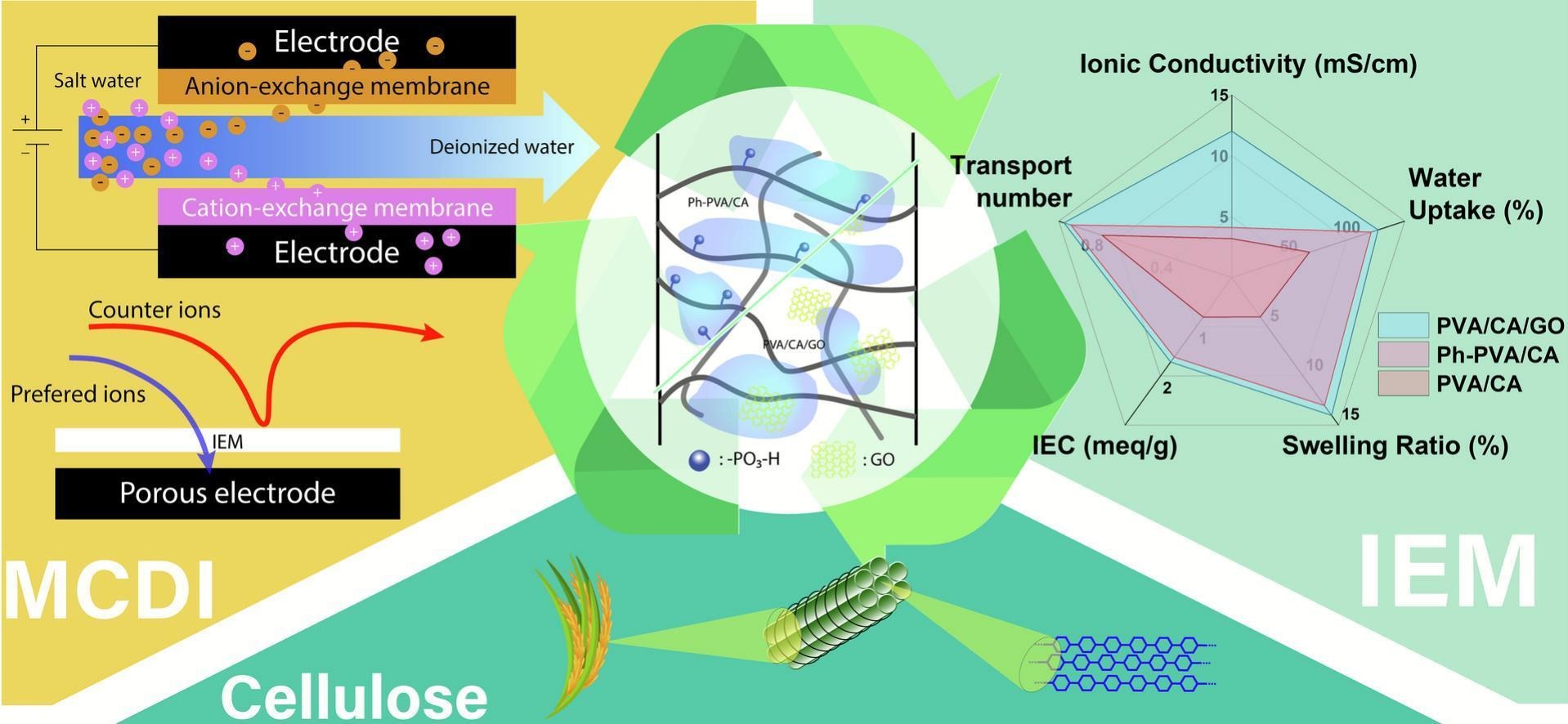
Membrane capacitive deionization (MCDI) has been investigated as a promising desalination technology, offering reduced operational voltage and enhanced electrode regeneration capability. Traditional materials used for ion exchange membranes rely on fluorinated polymers, which face drawbacks on fabricating processes and high cost. This study introduces a natural-based cellulose acetate membrane, with improvements by both chemical modification (phosphorylation) and physical blending (graphene oxide (GO) addition) option, and comparison between these enhancing pathways in MCDI application. The structure of synthesized membranes was investigated by Fourier-transform infrared and scanning electron microscopy. Several properties were used to evaluate the performance of the material, exhibiting the conductivity of 12.03 mS/cm, 120 % water uptake, stability up to 1.2 V and sustain against the radical oxidative test. The MCDI test shows that the phosphorylated CEM increases salt adsorption capacity to 12.52 mg/g, and the GO-doped shows stabilizing effect, supporting the ad-/desorption cycles in extended intervals.
Graphical abstract
Pham, H.T., Phan-Huynh, T.N., Nguyen, T.H., Phung, Q., Tran, T.T.V. and Hoang, D. (2026) Desalination, 620, p. 119628.