



Abstract
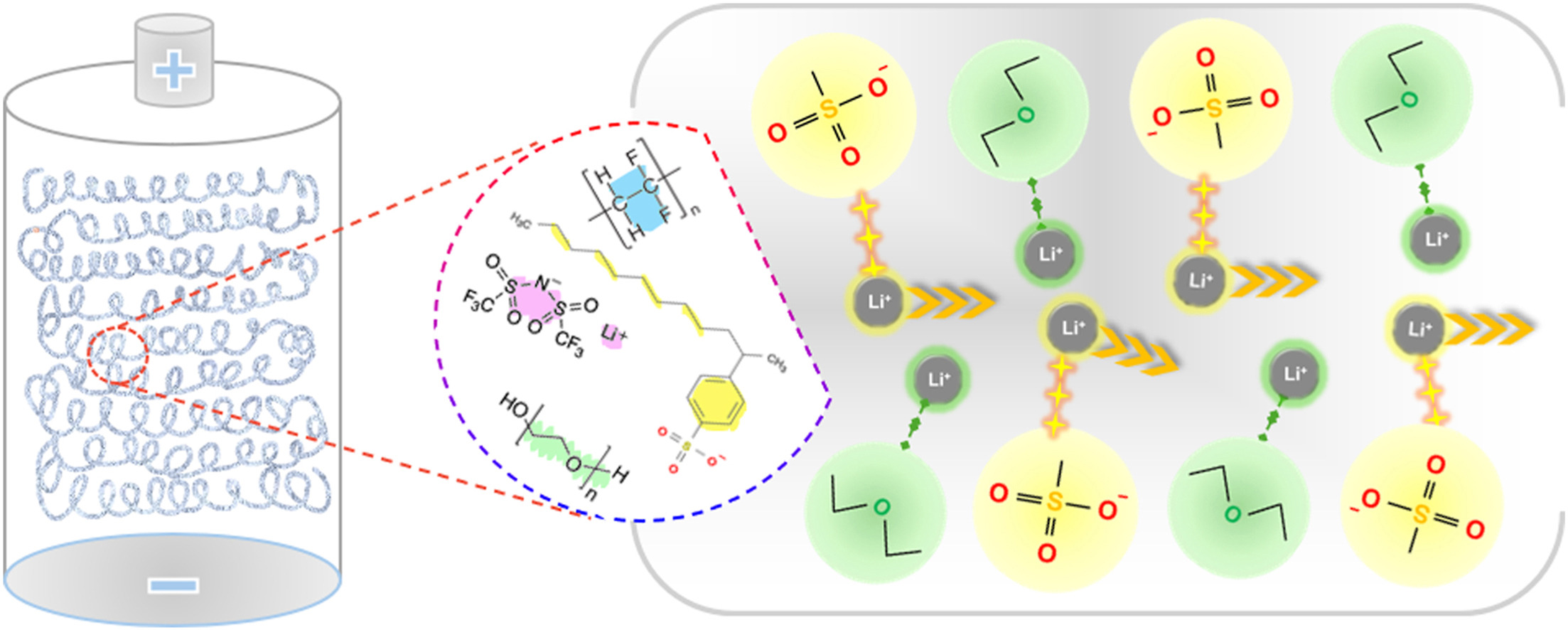
Safety concerns in lithium-ion batteries (LIBs) poses safety risks due to flammable liquid electrolytes and dendrite formation. Solid polymer electrolytes (SPEs) offer a safer alternative, though limited by low ionic conductivity and poor dendrite resistance. In this study, a SPE based on poly(ethylene oxide) (PEO) was modified to by blending with polyvinylidene fluoride (PVDF) to enhance mechanical strength and reduce crystallinity, while introducing sulfonate (SO3−) groups from linear alkylbenzene sulfonic acid (LABSA) to improve ion transport. At the optimized ratio of PEO:PVDF (1:0.7) and PEO:LAS (1:1.0), the SPE with LiTFSI exhibited high Li+ ion transference number (0.48) and improved diffusion coefficient. The symmetric Li||Li cell effectively suppressed dendrite formation during prolonged cycling. The LFP||Li cell delivered an initial discharge capacity of 148.4 mA h g−1 at 0.2C and retained over 80 % capacity after 100 cycles at 60 °C. These results highlight the effectiveness of sulfonate-functionalized polymer design in enhancing ionic transport and cycling stability in solid-state lithium batteries (SSLBs).
Graphical abstract
Vu, P.T., Nguyen, T.T.T., Le, P.L.M. and Tran, V.M. (2026) Journal of Power Sources, 661, p. 238612.