



Abstract
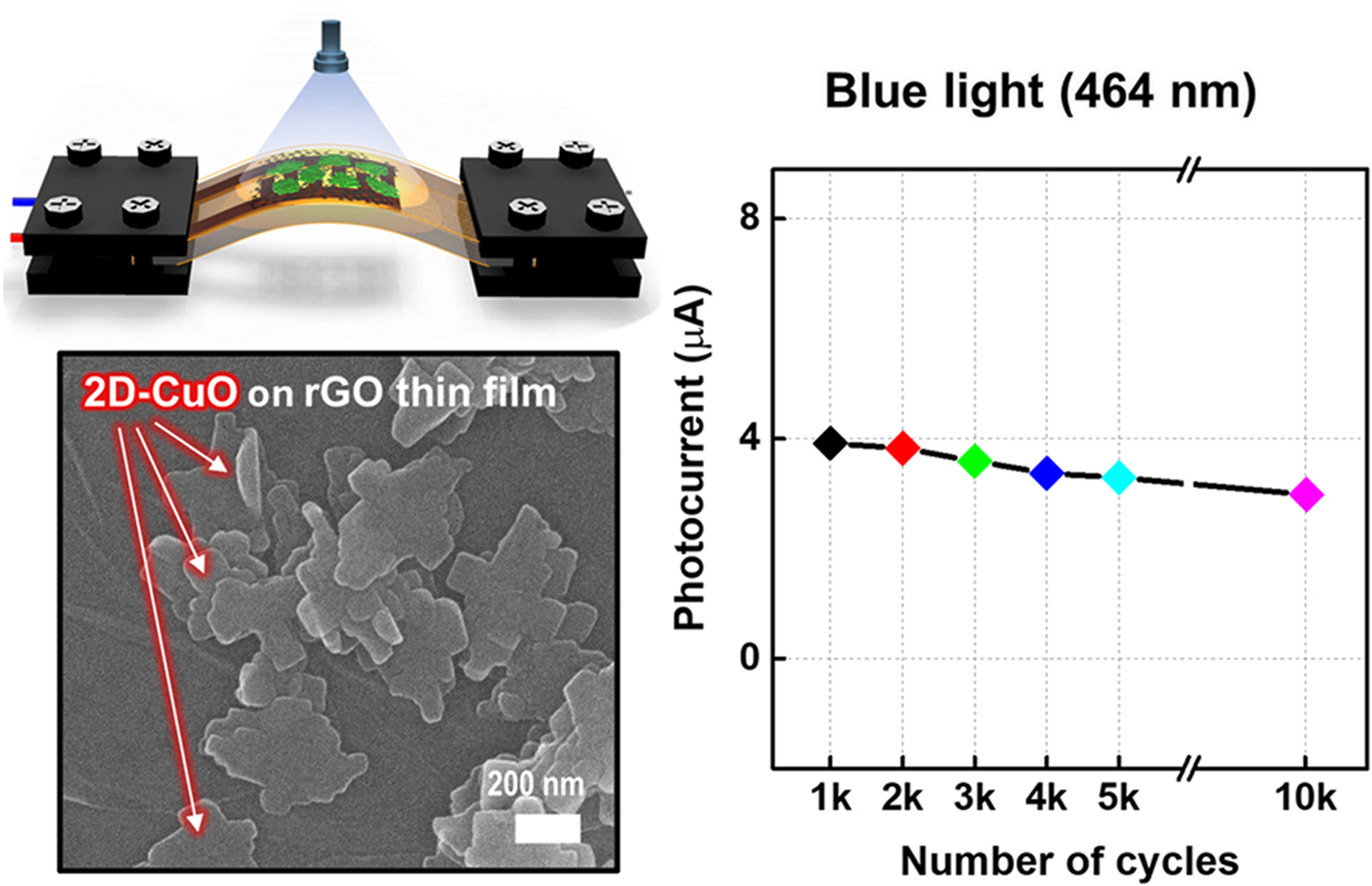
In recent years, the development of low-cost and flexible optoelectronic devices with minimal chemical usage has attracted increasing attention for sustainable development. This study introduces our development of a flexible visible photodetector based on a nanohybrid of copper oxide nanoflakes (2D-CuO) and reduced graphene oxide thin film (rGO), using just five initial materials. Particularly, the hydrothermal growth of 2D-CuO needs water and Cu salt, and the rGO production uses graphene oxide and hydrazine (reducing vapor). To build a flexible photodetector, instead of metal evaporation, low-power laser sintering can be employed to create electroconductive carbon electrodes from a polyimide substrate (i.e., carbonization of polyimide) before coating the active channel. The photoresistive device, consisting of the 2D-CuO/rGO active channel and carbon electrodes, shows stable operation under 464 nm visible light illumination at various bending radii of 4.2–12.2 mm. Notably, the flexible device exhibited consistent responsivity and photocurrent values with no significant degradation after 10,000 bending cycles (at 12.2 mm radius). That highlights the significance of this study, which paves the way for the development of sustainable applications, especially wearable sensor systems.
Graphical abstract
Ngo, D.A., Duy, L.T., Nguyen, N.M., Luu, K.Q., La, P.P.H., Bui, T.T.T., Tran, T.T.V., Tran, C.K. and Dang, V.Q. (2026) Optical Materials, 172, p. 117809.