



Abstract
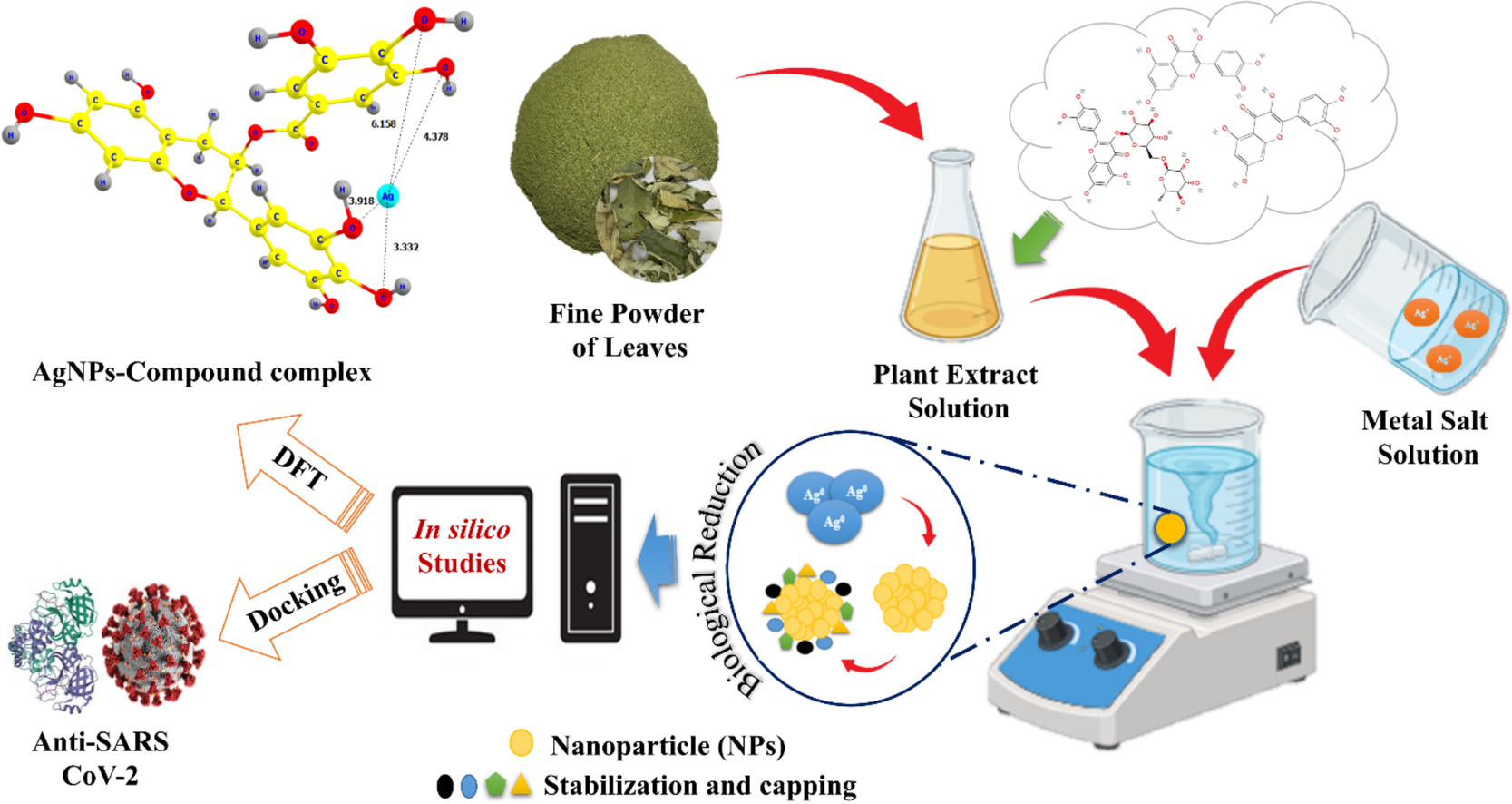
Camellia Chrysantha (Hu) Tuyama (CCT) is a valuable medicinal herb containing bioactive compounds with inhibitory activities against 3CLpro/Mpro of COVID-19. In this study, silver nanoparticles (AgNPs) were synthesized using the aqueous extract of CCT, and the role of CCT compounds in nanoparticle formation was investigated through combined experimental and computational approaches. Specifically, twelve major compounds were used for computational modeling, such as Catechin, Vitexin, Isovitexin, Quercetin-7-O-β-D glucopyranoside, Kaempferol, β-Amyrin, Friedelin, Friedelanol, Chondrillasterol, Epigallocatechin gallate (EGCG), Quercetin, and Rutin. The mechanism for stabilizing and reducing the Ag+ → Ago by density functional theory (DFT) was carried out at the B3LYP/cc-pVTZ level of theory. DFT-based analysis proved that Epigallocatechin gallate (EGCG) was mainly responsible for stabilizing AgNPs with a binding energy of −39.79 kJ/mol. In-silico studies showed that EGCG effectively penetrated the RBD-ACE2 interface, both in free form and when attached to AgNPs, with a binding energy of −9.72 kcal/mol, indicating potential antiviral activity.
Characterization of AgNPs confirmed successful synthesis: UV–vis spectral revealed a surface plasmon resonance (SPR) band at 486 nm, and Fourier transform infrared (FTIR) analysis confiírm the presence of functional groups on the CCT extract that act as reducing agents and stabilizers for AgNPs. The X-ray diffraction (XRD) pattern showed the face-centered cubic structure of AgNPs. The morphology and sizes of AgNPs were assessed by scanning electron microscope (SEM) and transmission electron microscopy (TEM), with TEM revealing an average size of 30.71 ± 6.31 nm, smaller than SEM measurements (43 ± 9 nm) due to the removal of the organic layer at high acceleration voltage. Dynamic light scattering (DLS) showed an average hydrodynamic size of 45.9 nm, while EDS confirmed a high Ag content (84.93 atomic%, 98.06 wt%), indicating successful nanoparticle formation and colloidal stability. As a result of computational and experimental studies, it can be helpful in designing a new anti-COVID drug for silver nanoparticles.
Graphical abstract
Trung, T.T., Loc, T.D., Si, N.T., Cong, N.T., Lenh, V.V., Do, P.-T., Nguyen, P.T.N. and Vo, K.Q. (2026) Inorganic Chemistry Communications, 186(Part 1), p. 116196.