



Abstract
Graphical abstract
Phan, N.N., Duong, H.Y., Nguyen, T.-K.-N., Ngo, T.T., Ngo, H.L., Bui, X.-T., Vo, T.-K.-Q., Nguyen, T.-Y.-P., Hatamoto, M., Watari, T. and Yamaguchi, T. (2026) Bioresource Technology Reports, 33, p. 102584.
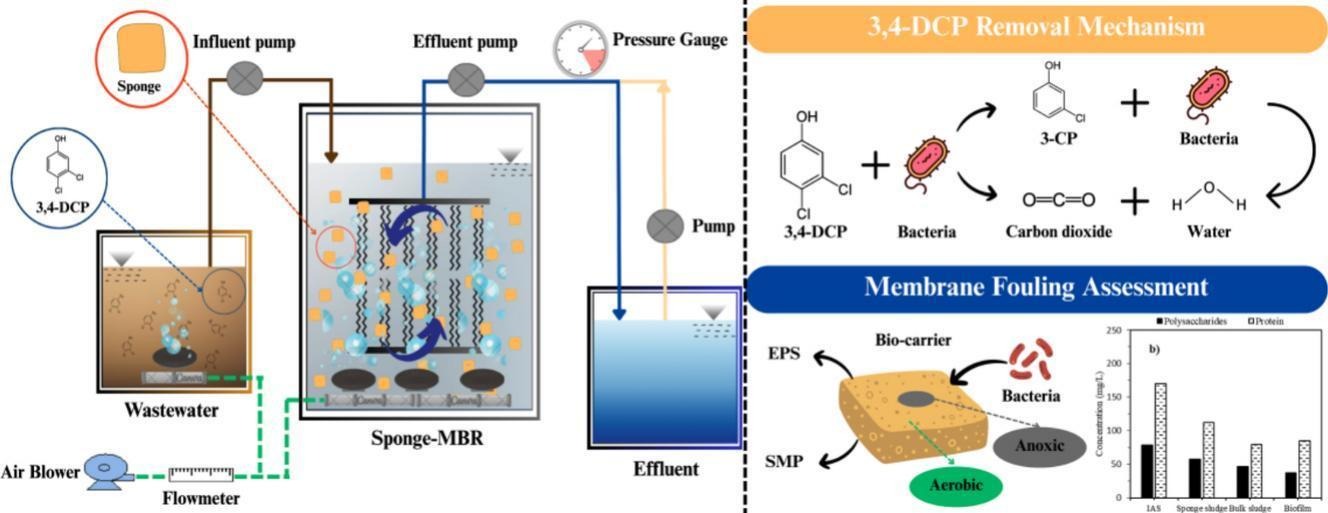
This study presents the first application of a lab-scale Sponge-Membrane Bioreactor (Sponge-MBR) for treating wastewater containing 3,4-dichlorophenol (3,4-DCP). The effects of hydraulic retention time (HRT) were initially evaluated at three levels (5, 10, and 15 h) to identify an optimal operating condition based on chemical oxygen demand (COD) and 3,4-DCP removal performance. Accordingly, an HRT of 15 h was selected and maintained for a subsequent 30 days operation to further assess system performance. At the optimal HRT, corresponding to an organic loading rate (OLR) of 2.84 ± 0.18 kg COD/(m3·day), the Sponge-MBR achieved stable removal rates of 356 ± 83 mg COD/(gMLSS·day) and 1.62 ± 0.38 mg 3,4-DCP/(gMLSS·day). Exposure to 3,4-DCP stimulated pronounced extracellular polymeric substances (EPS) production, with EPS concentrations consistently exceeding soluble microbial products, reflecting a microbial self-protection strategy under toxic stress. However, excessive accumulation of protein rich EPS substances within membrane associated biofilms led to intensified membrane fouling, as reflected by increased transmembrane pressure. Microbial analysis revealed clear differentiation in microbial community among bulk sludge, sponge sludge, and membrane biofilm. The recovery and predominance of Proteobacteria at longer HRTs were associated with stable removal of organic matter and chlorinated compounds. The findings suggest a potential benefit of Sponge-MBRs in reducing inhibitory effects of chlorinated organic pollutants, while indicating the co-occurrence of microbial protection and membrane fouling related to EPS substances.
Phan, N.N., Duong, H.Y., Nguyen, T.-K.-N., Ngo, T.T., Ngo, H.L., Bui, X.-T., Vo, T.-K.-Q., Nguyen, T.-Y.-P., Hatamoto, M., Watari, T. and Yamaguchi, T. (2026) Bioresource Technology Reports, 33, p. 102584.
| Cookie | Duration | Description |
|---|---|---|
| cookielawinfo-checkbox-analytics | 11 months | This cookie is set by GDPR Cookie Consent plugin. The cookie is used to store the user consent for the cookies in the category "Analytics". |
| cookielawinfo-checkbox-functional | 11 months | The cookie is set by GDPR cookie consent to record the user consent for the cookies in the category "Functional". |
| cookielawinfo-checkbox-necessary | 11 months | This cookie is set by GDPR Cookie Consent plugin. The cookies is used to store the user consent for the cookies in the category "Necessary". |
| cookielawinfo-checkbox-others | 11 months | This cookie is set by GDPR Cookie Consent plugin. The cookie is used to store the user consent for the cookies in the category "Other. |
| cookielawinfo-checkbox-performance | 11 months | This cookie is set by GDPR Cookie Consent plugin. The cookie is used to store the user consent for the cookies in the category "Performance". |
| viewed_cookie_policy | 11 months | The cookie is set by the GDPR Cookie Consent plugin and is used to store whether or not user has consented to the use of cookies. It does not store any personal data. |