



Abstract
Ethnobotanical relevance
Morus alba L. has been reported to exhibit various pharmacological effects, including antipyretic, hepatoprotective, nephroprotective, antihypertensive, and anti-inflammatory activities, as well as benefits for sore throat relief and eyesight improvement in traditional medicine.
Aim of the study
This study investigates the anti-inflammatory potential of two prenylated flavonoids isolated from the twigs of Morus alba L.
Methods
The methanol extract and ethyl acetate (EA)-soluble fraction exhibited inhibitory effects on nitric oxide (NO) production. These fractions were further purified using repeated open-column chromatographic techniques, including liquid–liquid partitioning, normal-phase (NP) and reversed-phase (RP) chromatography, Sephadex gel filtration, and preparative HPLC. The chemical structures of compounds 1 and 2 were elucidated based on comprehensive spectroscopic analyses, including 1D and 2D NMR, experimental circular dichroism (CD), and specific optical rotation, along with comparison to reported data in the literature. The inhibitory effects on NO production and cell viability were evaluated in RAW 264.7 macrophage cells using the MTT assay. In addition, molecular docking and pharmacokinetic property predictions were performed for the two promising compounds.
Results
The methanol extract and ethyl acetate (EA)-soluble fraction exhibited inhibitory effects on nitric oxide (NO) production, showing 65 % inhibition at 100 μg/mL. These fractions underwent bioassay-guided fractionation, leading to the isolation of morusoin A (1) and (−)-mulberranol (2), two bioactive prenylated flavonoids. Compounds 1 and 2 significantly inhibited NO production in a dose-dependent manner without affecting cell viability. Furthermore, molecular docking studies were performed to evaluate the interactions of these two flavonoids with key pro-inflammatory cytokines and transcription factors (iNOS, COX-2, TNF-α, IL-1β, IL-6, Nrf2, and NF-κB) to elucidate their potential anti-inflammatory mechanisms. The binding energies were calculated as −9.0/−8.0, −9.1/−9.6, −6.0/−6.2, −6.0/−5.6, −6.5/−6.8, −7.1/−9.4, and −8.8/−9.5 kcal/mol, respectively. In addition, in silico ADMET and toxicity analyses were performed, providing an overview of the pharmacokinetic and safety profiles of the two compounds.
Conclusion
Compounds 1 and 2 have been well studied for isolation, structural elucidation, and their anti-inflammatory effects using both in vitro and in silico approaches and indicated that 1 and 2 possessed potential anti-inflammatory activity mediated via the Nrf2/NF-κB signaling pathway, warranting supporting their further evaluation in in vitro and in vivo models.
Graphical abstract
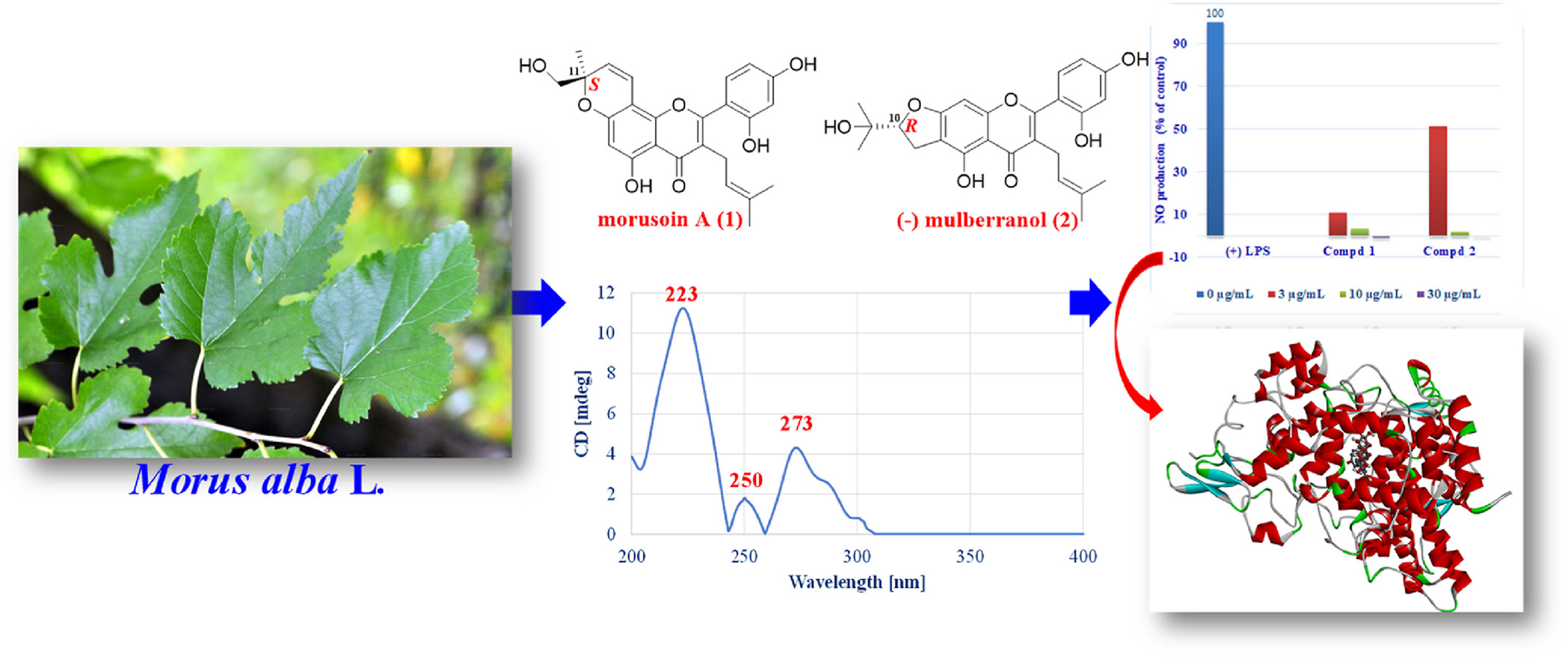
Tran, L.V.H., Vo, H.C., Nguyen, T.D.L., To, H.L., Le, M.-T., Thai, K.-M., Nguyen, T.L., Nguyen, V.-K. and Tran, H.N.K. (2026) Journal of Ethnopharmacology, 360, p. 121179.