



Abstract
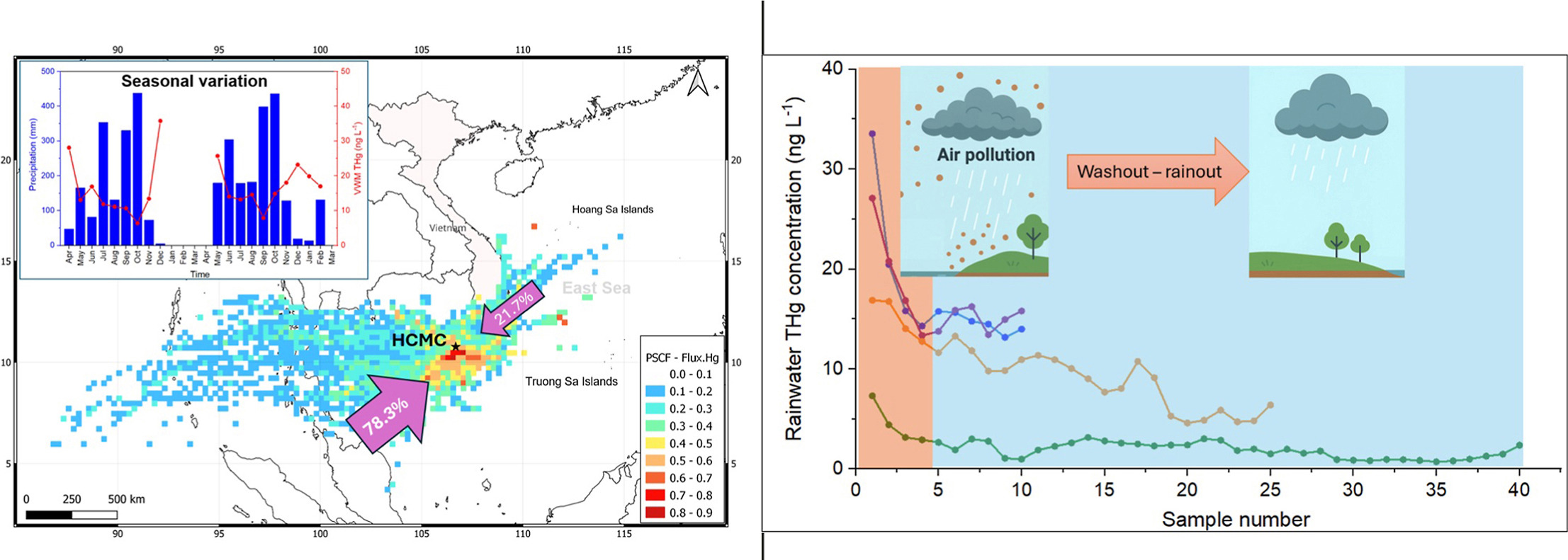
Atmospheric deposition is a critical process in the global mercury (Hg) cycle, particularly in tropical regions with intense precipitation. However, observational data of Hg deposition remains scarce, particularly across the tropical Southeast Asia region. This study presents two years of wet deposition measurements in Ho Chi Minh City (HCMC), a tropical urban megacity in southern Vietnam. THg concentration ranged from 1.87 to 47.1 ng L−1, with the volume-weighted mean (VWM) THg concentration of 14.5 ng L−1. The annual Hg deposition flux was estimated to be 27.6 μg m−2 yr−1, indicating substantial atmospheric Hg input to HCMC. Seasonal variations were evident, with significantly higher THg concentrations observed during the dry season (December-April). In contrast, deposition fluxes peaked during the rainy season (May-November), driven by enhanced precipitation amount despite lower concentrations. Approximately 78.3% of Hg deposition in HCMC was attributed to south-southwest transport pathways associated with the East Asian monsoon, as indicated potential source contribution function. Principal component analysis revealed that Hg originates from multiple sources, dominated by anthropogenic combustion and influenced by meteorological conditions. A marked decline in THg concentrations within the first 5-10 min of precipitation indicated the importance of below-cloud scavenging. This phase was typically followed by a relatively stable THg concentration period, during which differences among events suggested variation in cloud scavenging efficiencies. The estimated precipitation depth required for full washout efficiency was 6-7 mm. Our study provides critical insights for supporting the development of Hg emission mitigation strategies in rapidly urbanizing tropical urban environments.
Graphical abstract
 Nguyen, L.S.P., Le, Q.H., Nguyen, T.T. and To, T.H., 2026. Atmospheric Environment, 382, p.122257.