

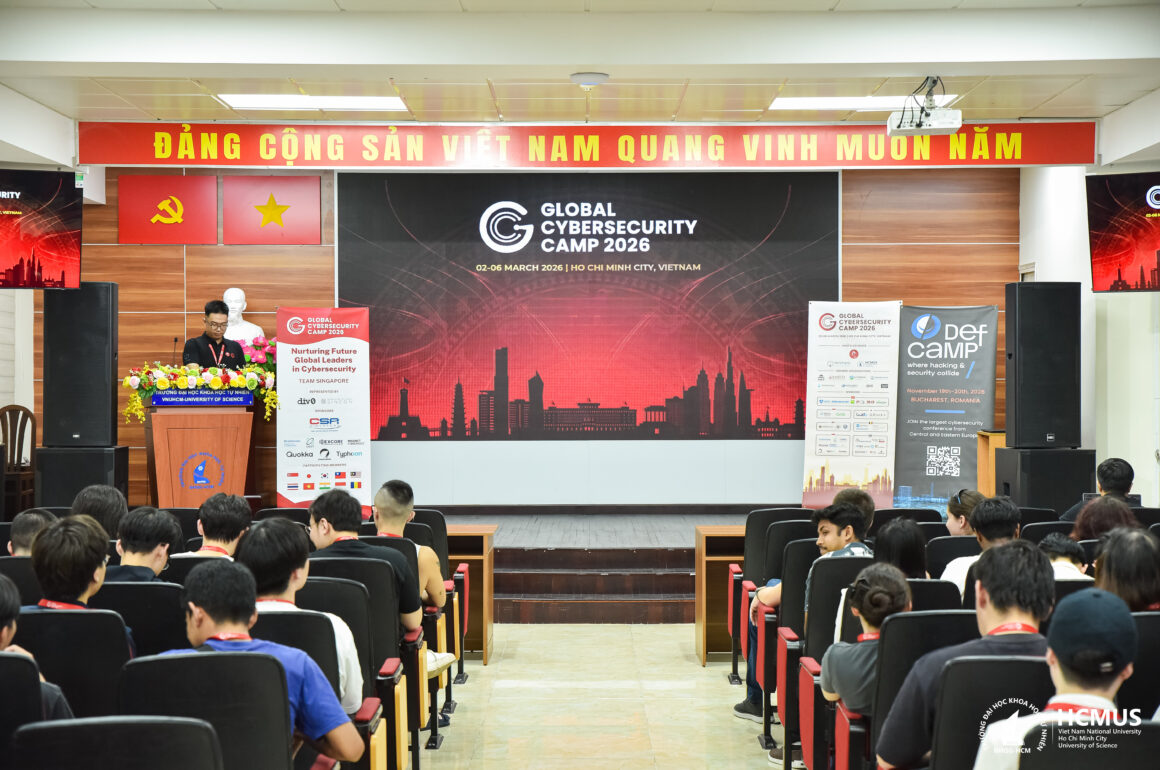
Global Cybersecurity Camp 2026 (GCC 2026) – chương trình huấn luyện an ninh mạng quốc tế quy tụ gần 50 học viên xuất sắc đến từ 9 quốc gia và vùng lãnh thổ – đã chính thức khai mạc tại cơ sở Nguyễn Văn Cừ, Trường Đại học Khoa học tự nhiên, ĐHQG-HCM, mở ra một tuần đào tạo chuyên sâu và tăng cường kết nối hợp tác toàn cầu trong lĩnh vực an ninh mạng. Tối 01/3/2026, chương trình huấn luyện quốc tế về an ninh mạng Global Cybersecurity Camp 2026 (GCC 2026) đã chính thức khởi động tại...

Thông tin dành cho sinh viên
Thông báo ghép các lớp Kinh tế ĐC, Lịch sử Đảng, PP luận sáng tạo do không đủ số lượng đăng ký tại cơ sở 2
Phòng Đào tạo thông báo: 1. Ghép các lớp Kinh tế ĐC, Lịch sử Đảng, PP luận sáng tạo do không đủ số lượng đăng ký tại cơ sở 2, áp dụng từ 02/03/2026. Trường đã chuyển sv các lớp này vào lớp khác có cùng TKB. 2. Chia lại danh sách lớp Lịch sử Đảng, chiều Thứ Sáu tại cơ sở 2, áp dụng từ 02/03/2026. Sinh viên xem các lớp tại file theo link đính kèm, đồng thời xem kết quả trên hệ thống portal để học theo đúng lịch. https://docs.google.com/spreadsheets/d/1XNUTkqcr7IxOQIK58I1U1J–Ul3sXWmv/edit?gid=1817892629#gid=1817892629
Thông tin dành cho sinh viên
Thông báo cập nhật TKB Thể dục 2 HK2/2025-2026
Cập nhật TKB Thể dục 2 (có thông tin giảng viên). Sinh viên xem thông tin cụ thể trong link sau dây: https://docs.google.com/spreadsheets/d/1zIKzE3xfMYYaZmzDmC21mEj7LoM2bK9Y/edit?gid=1657207096#gid=1657207096
Bài báo khoa học
Short-Packet Communications for Pinching-Antenna Systems
Abstract In this letter, we study the average block error rate (BLER) performance of short-packet communications (SPC) for pinching-antenna systems (PASS). A base station equipped with a pinching antenna serves an Internet of Things downlink user using SPC. Closed-form expressions for the average BLER of SPC for PASS networks are analytically derived under in-waveguide attenuation. Simulation results demonstrate that PASS-aided SPC networks significantly outperform conventional fixed-antenna-aided SPC systems in terms of BLER, especially in the low in-waveguide attenuation regime. Nguyen, T.-T.T., Nguyen, X.-X. and Nguyen, N.V.T. (2026) IEEE Communications Letters, 30, pp. 1270–1274. DOI: https://doi.org/10.1109/LCOMM.2026.3669227
30 năm / Góc kỷ niệm / Story
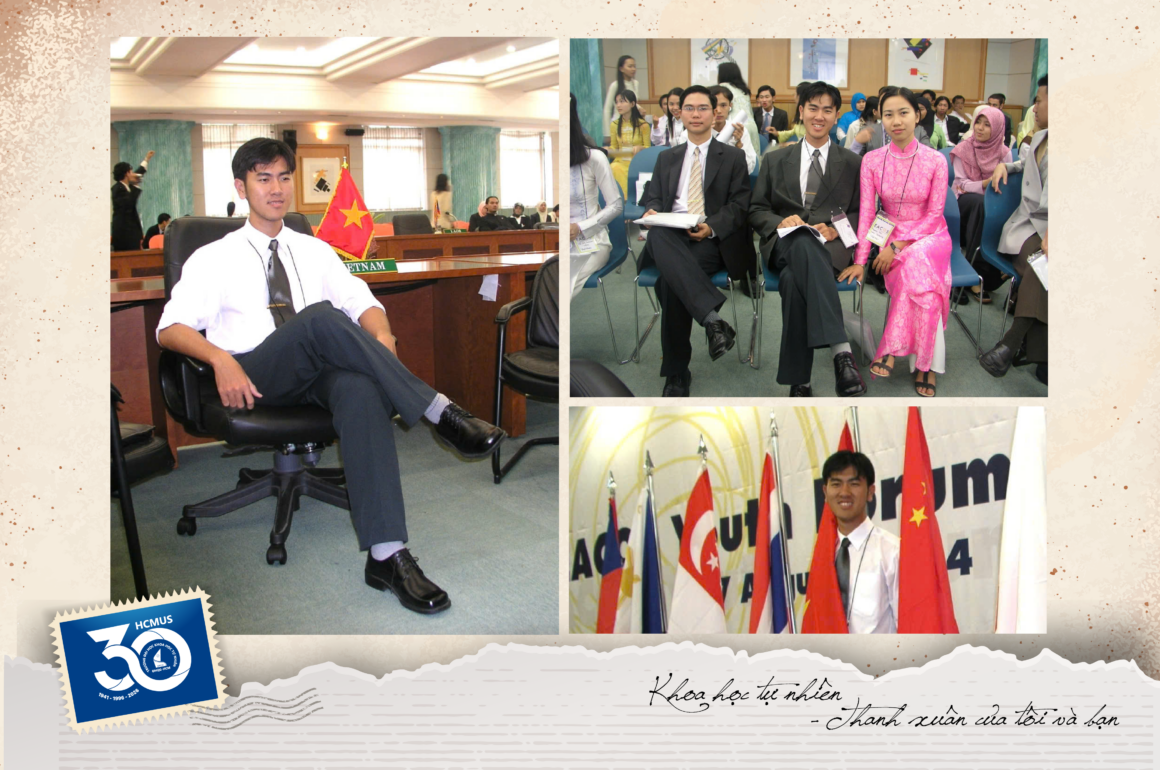
💌 #HCMUS30 | Lời chúc 02
“Khi được hỏi về khoảnh khắc xúc động nhất trong quãng thời gian gắn bó với Trường, có lẽ là 3 dấu mốc: thời nhập học tháng 9/2001, lúc tham gia Mùa Hè Xanh lần đầu năm 2002, và tại Lễ tốt nghiệp năm 2005. Mỗi khoảnh khắc đều đánh dấu sự trưởng thành về kiến thức và nhận thức mà môi trường học thuật và rèn luyện của trường khoa học tự nhiên đã giúp tôi có được.Với tôi, Trường Đại học Khoa học tự nhiên trong tôi là một ngôi nhà, một người thầy và là một người...
Sau đại học / Tin tức
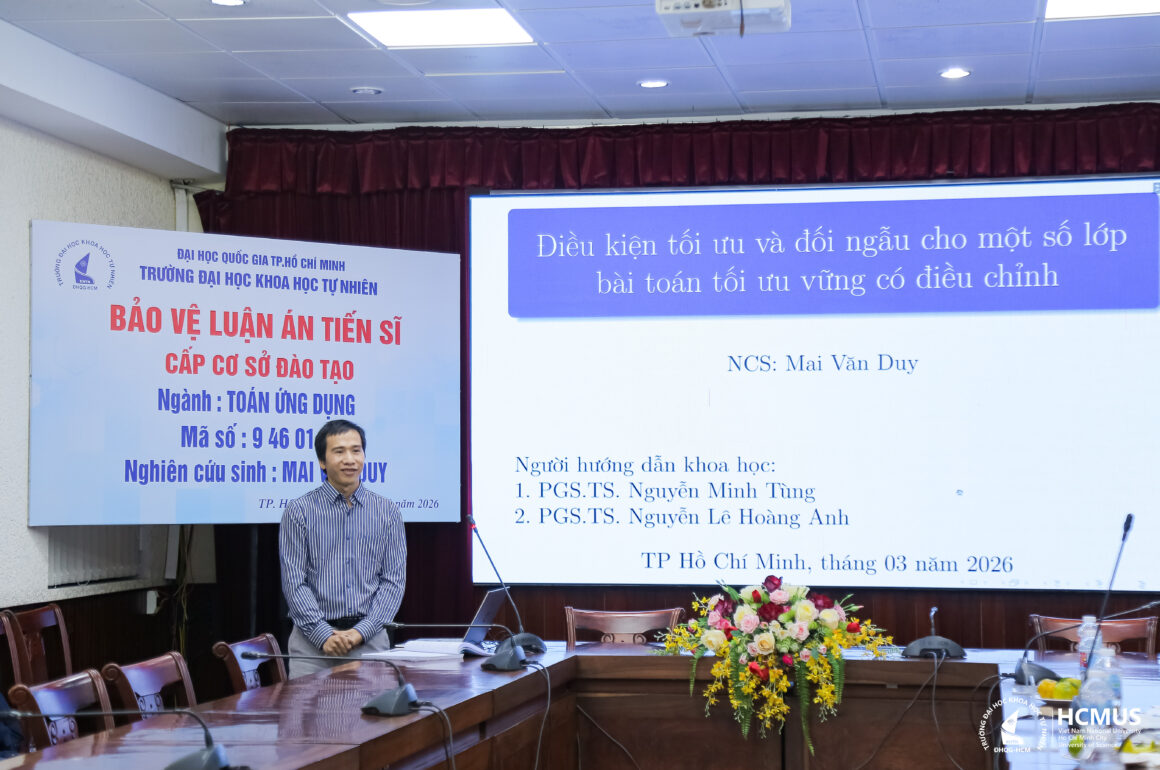
NCS Mai Văn Duy bảo vệ thành công luận án tiến sĩ ngành Toán ứng dụng
Ngày 01/03/2026, tại Trường Đại học Khoa học tự nhiên, ĐHQG-HCM, nghiên cứu sinh Mai Văn Duy đã bảo vệ thành công luận án tiến sĩ cấp cơ sở đào tạo ngành Toán ứng dụng với đề tài “Điều kiện tối ưu và đối ngẫu cho một số lớp bài toán tối ưu vững có điều chỉnh”. Luận án được thực hiện dưới sự hướng dẫn khoa học của PGS.TS. Nguyễn Minh Tùng và PGS.TS. Nguyễn Lê Hoàng Anh. Luận án tập trung nghiên cứu điều kiện tối ưu và các mô hình đối ngẫu cho một số lớp bài...
Sau đại học / Tin tức
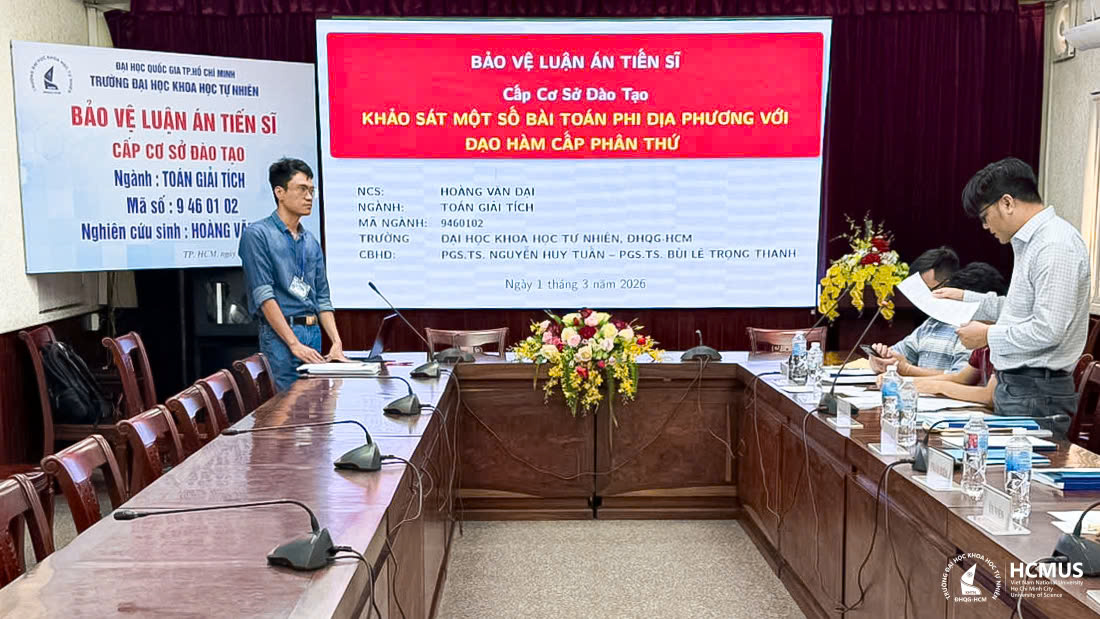
NCS Hoàng Văn Đại bảo vệ thành công luận án tiến sĩ ngành Toán giải tích
Sáng 01/03/2026, tại Trường Đại học Khoa học tự nhiên, ĐHQG-HCM, nghiên cứu sinh Hoàng Văn Đại (khóa 2022, ngành Toán giải tích) đã bảo vệ thành công luận án tiến sĩ với đề tài “Khảo sát một số bài toán phi địa phương với đạo hàm cấp phân thứ”. Luận án được thực hiện dưới sự hướng dẫn khoa học của PGS.TS. Nguyễn Huy Tuấn và PGS.TS. Bùi Lê Trọng Thanh. Trong phần trình bày, nghiên cứu sinh tập trung làm rõ ba nhóm bài toán thuộc lĩnh vực phương trình đạo hàm riêng, gồm: bài toán phi địa...

Bài báo khoa học
Fusing global attention and self-attention for better performance and interpretability on tabular data
Abstract Deep learning has demonstrated remarkable success across domains such as image, audio, video, and text processing. However, its application to tabular data remains challenging due to the heterogeneous nature of features and the lack of positional information, which complicates feature interaction modeling. While deep learning approaches for tabular data have achieved performance levels comparable to traditional methods like gradient boosting machines, their adoption in real-world scenarios is limited by issues of interpretability and robustness. We introduce FusANet (Fusion Attention Neural Network), a novel parametric transformer-style architecture for tabular data that fuses a dataset-level global attention map with instance-level local self-attention using...
Bài báo khoa học
Tuning Sodium Source Chemistry for Enhanced Structural Homogeneity and Kinetic Properties of Sol–Gel Layered Cathode in Sodium-Ion Batteries
Abstract The sol–gel technique offers a versatile route for synthesizing electrode materials with reduced and uniform grain sizes, enabling the development of high-performance cathodes for next-generation sodium-ion batteries (SIBs). Achieving high-performance layered oxide cathodes requires control over chemical homogeneity and phase composition. Herein, we investigate the feasibility of tuning the structural integrity, electrochemical behavior, and Na+ transport kinetics of NaFe0.5Co0.5O2 using different external sodium sources (Na2CO3 and NaOH) combined with sol–gel-derivated transition metal oxide precursor. Characterization using X-ray diffraction, scanning electron microscopy, and X-ray photoelectron spectroscopy reveals distinct surface constituents and morphological differences between the samples obtained by conventional and modified sol–gel routes....
Bài báo khoa học
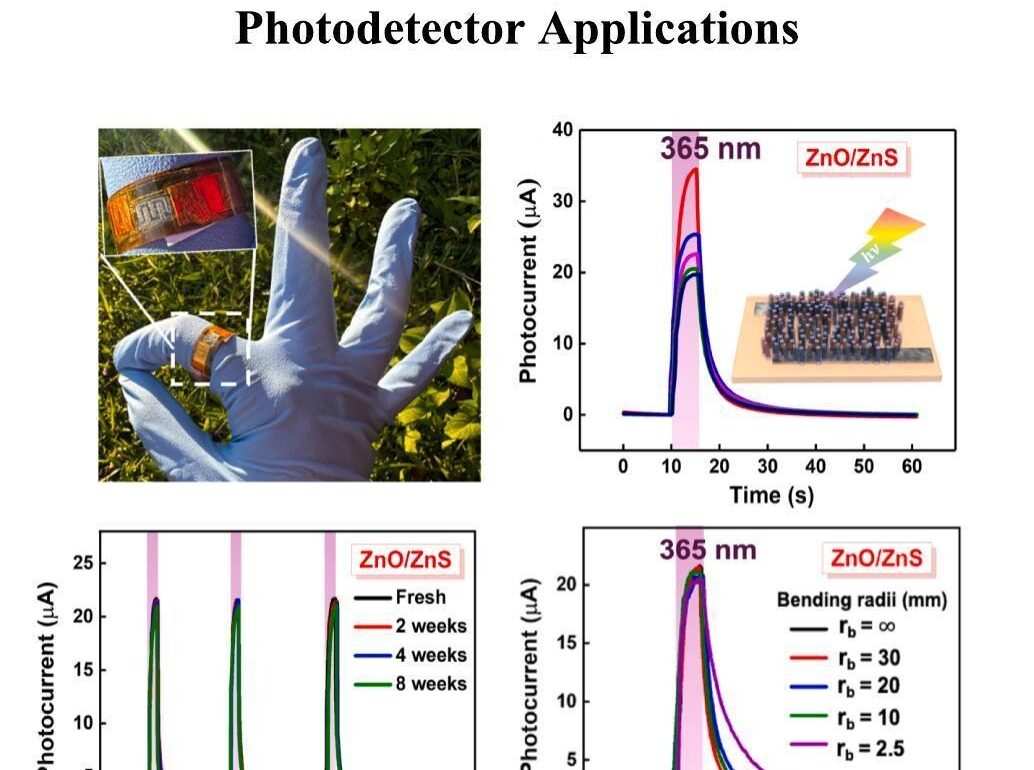
Surface engineering of vertical ZnO nanorods via green sulfurization strategy for flexible photodetector applications
Abstract In the Internet of Things era, flexible photodetectors have received significant attention for applications in wearable electronics and human–machine interfaces. ZnO nanorods, known as a large bandgap semiconductor, is a promising candidate for flexible photodetectors; however, it still has some limitations for practical use, especially low response and humidity interference. Thus, to overcome these challenges, our study on surface engineering of ZnO nanorods via a sulfurization strategy to form ZnO/ZnS core/shell structure by using a low-cost, fast, and green route is proposed. Furthermore, sulfurized ZnO-based flexible photodetectors using laser-patterned carbon electrodes are developed. The effects of the sulfurization strategy...