



Abstract
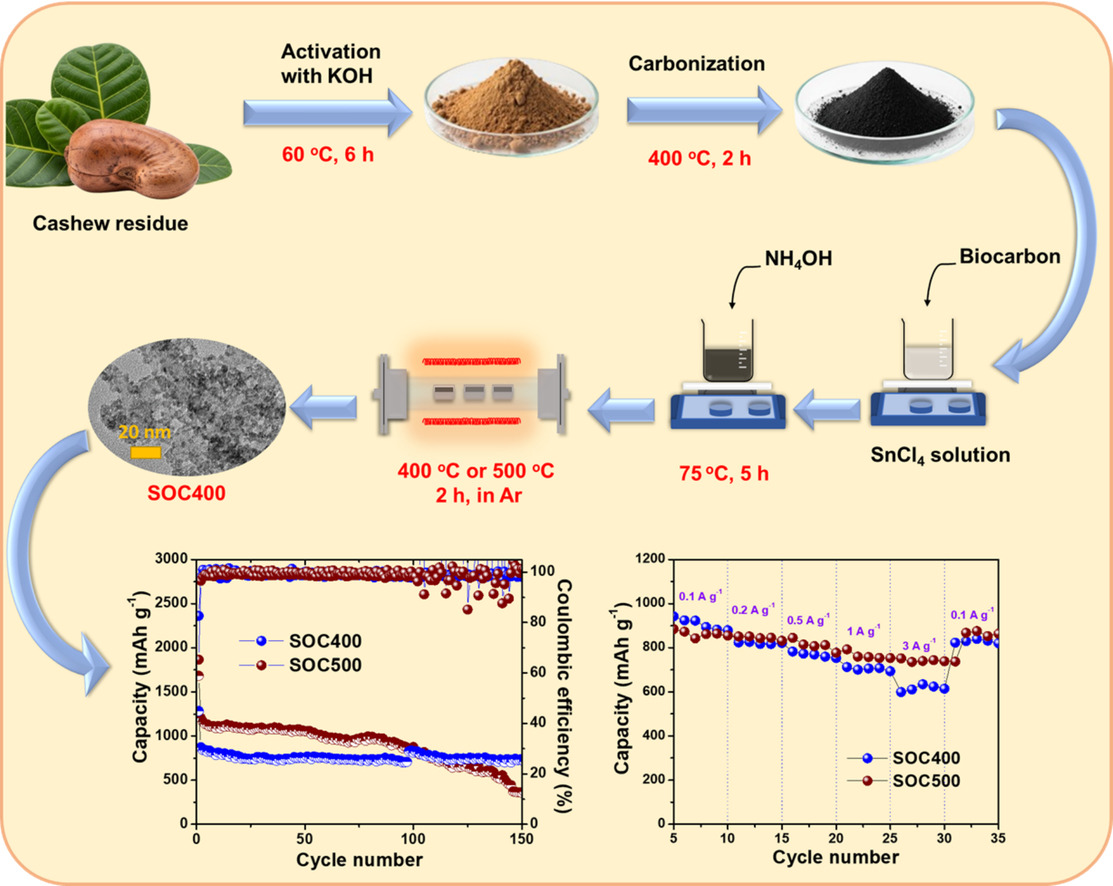
In the present work, composites of SnO2 and biocarbon from cashew residue were applied and reported for the first time as anode materials of Li-ion batteries. The composites were developed via a two-step synthesis route consisting of pretreating the cashew residue to create biocarbon, followed by compositing the biocarbon with SnO2. The calcination temperatures were set at 400 °C and 500 °C, and the synthesized samples were denoted as SOC400 and SOC500, respectively. These temperature points were chosen to be significantly lower than those used in previous studies to reduce production costs and enhance commercial competitiveness. The properties and morphologies of the SOC materials were investigated using advanced analyses, which revealed that the composites contained SnO2 nanoparticles approximately 9–10 nm in size, present in both crystalline and amorphous phases and homogeneously distributed on the biocarbon sheets. Due to this characteristic structure, the SOC400 electrode demonstrated impressive performance with the capacity maintained at 739 mAh g−1 after 150 cycles. Besides, the rate-capacity test demonstrated the effective performance of SOC electrodes at high current densities, with capacities reaching 632 and 742 mAh g−1 for the SOC400 and SOC500 electrodes at 3 A g−1, respectively. Electrochemical impedance spectrum analysis confirmed that the SOC400 electrode had a lower total resistance than the SOC500 electrode. In addition, kinetic analysis indicated that the charge storage via pseudocapacitance mechanism of the SOC400 electrode was more robust than that of the SOC500 electrode. Combining high capacity, notable cycling stability, high pseudocapacitance, and good rate capability, the SOC400 material is considered a prospective anode material for future Li-ion batteries.
Graphical abstract
Bui, T.T.N., Phan, V.N., Nhi, T.N., Pham, T.K., Tran, H.M., Nguyen, T.N., Pham, L.T., Tran, M.V., Nguyen, Q.H., Nguyen, T.L. and To, G.T. (2026) Inorganic Chemistry Communications, 185, p. 116081.