



Abstract
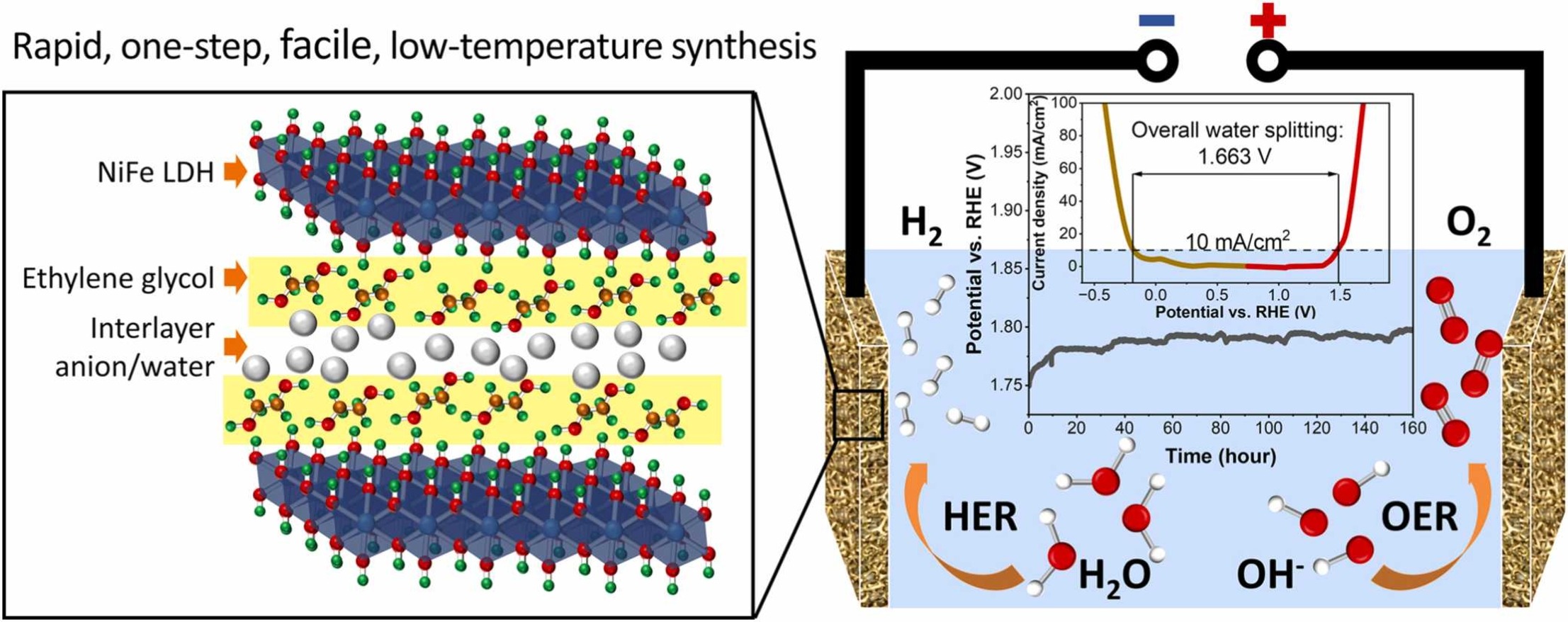
Developing cost-effective, durable, and efficient bifunctional electrocatalysts is essential for advancing green hydrogen production. Here, we report a rapid, one-step, room-temperature, corrosion-driven strategy for directly constructing nickel-iron layered double hydroxides (NiFe LDH) on nickel foam (NF), where the NF serves as both the conductive substrate and the sole Ni source. In an Fe3 + -ethylene glycol (EG) solution, controlled corrosion of the NF surface released Ni2+, enabling the in situ formation of NiFe LDH without external heating or additional Ni precursors. EG plays a dual regulatory role by moderating Fe3+ hydrolysis and increasing solution viscosity, thereby controlling corrosion kinetics, nanosheet formation, and charge-transfer behavior. An optimal EG content enables balanced corrosion-reprecipitation growth and effective Fe incorporation. Further tuning of the Fe3+ concentration regulates the Ni/Fe ratio and reaction-dependent catalytic performance, highlighting the importance of balancing active-site accessibility and interfacial charge-transfer efficiency. The optimized electrode pair demonstrates efficient overall water-splitting with excellent durability and high Faradaic efficiency. This work provides mechanistic insight into EG-regulated, corrosion-driven LDH synthesis and offers a scalable and energy-efficient pathway for designing high-performance electrocatalysts for alkaline water electrolysis.
Graphical Abstract
Nguyen Do, K.A., Tran, K.T.T., Le, M.H., Huynh, T.M. and Tran, M.V. (2026) Journal of Alloys and Compounds, 1065, p. 188040.