

Abstract
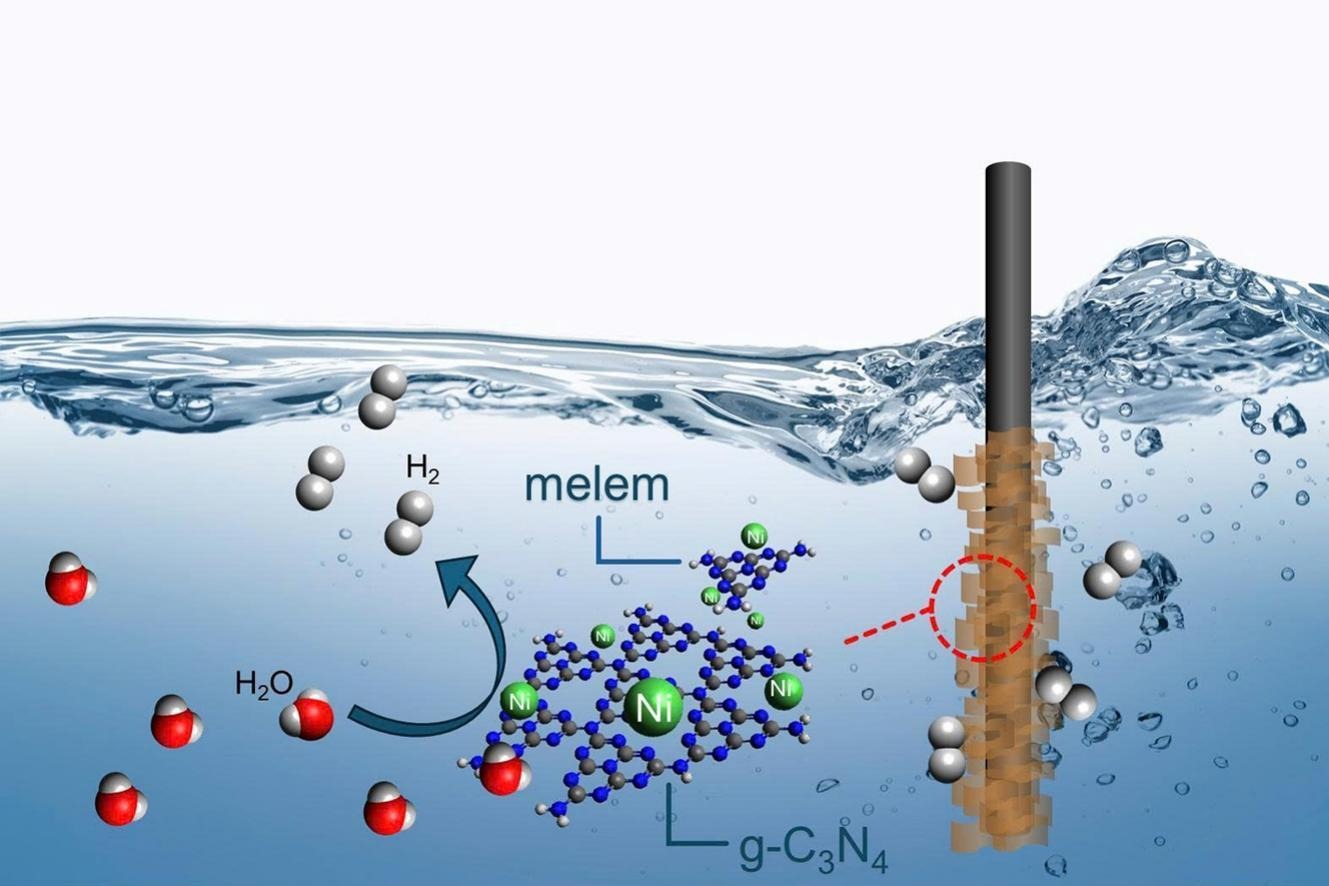
Graphitic carbon nitride (g-C3N4) has been widely used as a material for hydrogen evolution reaction (HER) due to its visible-light activity, low cost, and non-toxicity. However, a rapid recombination of photogenerated electron-hole pairs, poor electrical conductivity, and a low specific surface area of g-C3N4 have hindered its practical performance. Melem/g-C3N4 (abbreviate: MCN) is a newer structure than g-C3N4 and has better light absorption as well as lower electron/hole recombination than pristine g-C3N4. Herein, we report on loading different amounts of nickel nanoparticles (Ni NPs) onto supramolecule-based MCN using chemical reduction. The results showed that incorporating Ni NPs on the surface of MCN has further promoted spatial charge separation as well as supplied more active sites, ultimately improving its water splitting efficiency. Besides, 1.5Ni/MCN (prepared by solution containing 1.5% Ni2+) exhibits the superior HER performance with the lowest overpotential (781 mV) and Tafel slope of (196.1 mV.dec−1) compared to the others. Additionally, this concept implies that it is possible to control the recombination process and active sites separately, which is the key to enhancing the water splitting process.
Graphical abstract
Nguyen, M.D., Trinh, P.V.C., Nguyen, T.Q., Tran, K.V., Tran, M.V., Anus, A., Park, S. and Pham, V.V. (2026) Journal of Photochemistry and Photobiology A: Chemistry, 477, p. 117123.