


Abstract
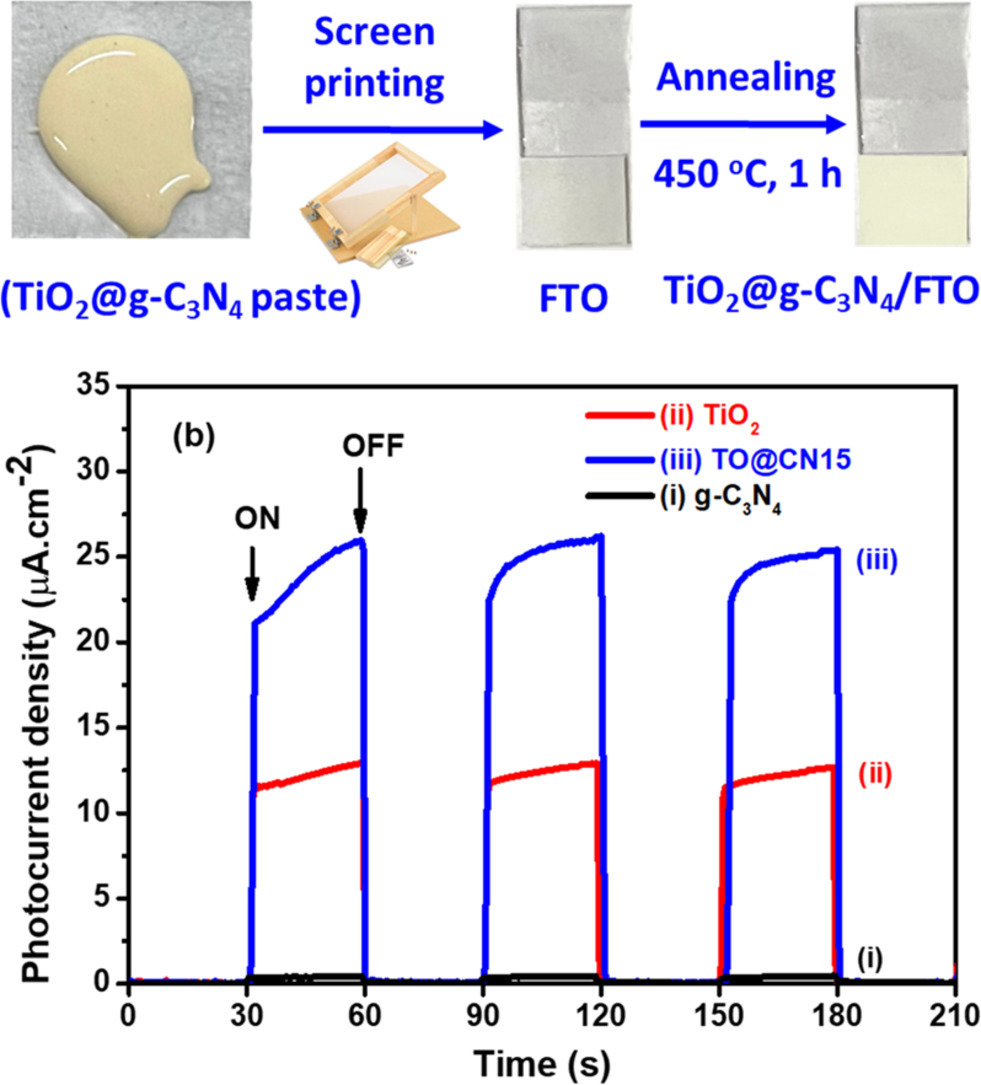
In this work, TiO2@g–C3N4 was synthesized and formulated as a novel ready-to-use screen-printable paste for water splitting applications. Various analytical methods were employed to examine the composition, morphological characteristics, and optical properties of the individual materials and the resulting heterojunction. Photoelectrochemical (PEC) water splitting was investigated under illumination of 100 mW cm-2 using linear chopped-light chronoamperometry (CA) and linear sweep voltammetry (LSV) techniques. The results affirmed the successful fabrication of TiO₂@g–C₃N₄ heterojunction photoelectrodes. The sample prepared using a paste containing 15% g–C₃N₄ (TO@CN15) exhibited a significant enhancement in photocurrent response. The OER achieves 10 mA cm⁻² at an impressively low overpotential (η₁₀) of 98 mV in 1 M KOH. The TiO₂@g–C₃N₄ sample exhibits a pronounced improvement in OER photocurrent density at zero bias compared to pristine TiO₂, with enhancements of 2-fold (26 vs. 13 µA cm⁻²) in 1 M KOH and 5.5-fold (22 vs. 4 µA cm⁻²) in 1 M Na₂SO₄. A Z-scheme charge transfer is proposed to shed light on the enhanced photoelectrochemical performance of the TiO₂@g–C₃N₄ heterojunction photoelectrode.
Graphical abstract
Ngoc, H.C., Anh, K.H.N., Nguyet, A.T.D., Ngan, K.T.N., Viet, V.P., Hoang, T.N. and Hai, V.L. (2026) Electrochimica Acta, 549, p. 148071.