
Abstract In this paper, we propose two projected dynamical systems for solving inverse quasi-variational inequality problems in finite-dimensional Hilbert spaces–one ensuring finite-time stability and the other guaranteeing fixed-time stability. We first establish the connection between these dynamical systems and the solutions of inverse quasi-variational problems. Then, under mild conditions on the operators and parameters, we...
Thẻ: SDG9-Công nghệ – sáng tạo và phát triển hạ tầng
Viscoelastic strain recovery governs crack-tip opening dynamics of elastomers
Abstract This study explores the crack opening dynamics in Mode-I fracture of pre-stretched viscoelastic elastomer sheets under varying strain energy release rate (Γ). The degree of viscoelasticity was widely tuned by altering the mixing ratio of telechelic precursor chains and a tri-functional cross-linker, producing elastomers with different amounts of relaxation components such as dangling chains...
Ab initio kinetics of the pyrene + OH reaction: a revisited study
Abstract Pyrene belongs to the highly toxic class of polycyclic aromatic hydrocarbons and has carcinogenic properties; thus, the kinetics of its OH-initiated oxidation is theoretically investigated in a wide range of conditions (T = 200-2000 K and P = 7.6-76,000 Torr). The T & P-dependent kinetic behaviors were studied within the stochastic RRKM-based master equation framework with the potential energy profile...
THÔNG BÁO HỘI THẢO QUỐC GIA CÔNG NGHỆ, ĐỔI MỚI SÁNG TẠO TRONG XÂY DỰNG, KIẾN TRÚC GIAO THÔNG VẬN TẢI VÀ KINH TẾ 2026
CV 11 thu moi tham gia Hoi thao KH TB L1_ICATE 2026 02-HuongDan_TomTat_2026
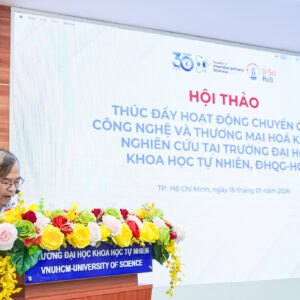
THƯ MỜI THÚC ĐẨY CHUYỂN GIAO CÔNG NGHỆ VÀ THƯƠNG MẠI HÓA KẾT QUẢ NGHIÊN CỨU TẠI TRƯỜNG ĐH KHTN, ĐHQG-HCM
Thư mời quý thầy cô Thư mời quý doanh nghiệp Chương trình hội thảo
Nonexistence Results for a Singular Quasilinear Anisotropic Equation
Abstract We establish the nonexistence of positive stable solutions u ∈ W loc 1 , p ( R N ) to the singular quasilinear anisotropic equation Δ B H u = u − q in R N , where q > 0 , in low dimensions. Under similar assumptions, we further prove that, for the...
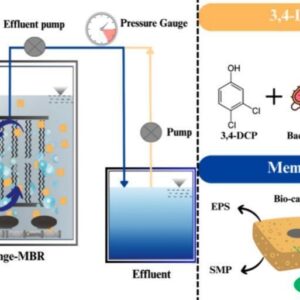
Enhanced nitrogen removal in sponge membrane bioreactor coupled with iron scraps for municipal wastewater treatment: Performance and microbial community shifts
Abstract This study investigates the performance of a sponge membrane bioreactor (SMBR) integrated with waste iron scraps as an innovative approach to enhance nitrogen removal from municipal wastewater. The incorporation of iron scraps substantially improved the total nitrogen (TN) removal efficiency, increasing from 35.3 ± 10.4 % to 62.4 ± 26.9 %, while maintaining stable chemical oxygen demand (COD) removal above...
GS.TS Trần Thị Thanh Vân: “Tương lai luôn rộng mở cho những người dám ước mơ và kiên trì”
Năm 2025, trong tổng số 08 ứng viên ngành Vật lý được Hội đồng Giáo sư Nhà nước công nhận đạt chuẩn giáo sư, chỉ có một nhà khoa học nữ – GS.TS Trần Thị Thanh Vân, Trưởng Khoa Khoa học và Công nghệ vật liệu, Trường ĐH Khoa học tự nhiên. Ở tuổi 45,...
Chemical and microstructural characterization of graft-type polymer electrolyte membranes
Abstract The chemical and microstructural features of poly(styrenesulfonic acid) (PSSA)-grafted poly(ethylene-co-tetrafluoroethylene) (ETFE) polymer electrolyte membranes (ETFE-PEMs) through preparation procedures and grafting degree (GD) are investigated by solid-state 13C cross polarization/magic angle spinning solid-state nuclear magnetic resonance (13C CP/MAS NMR) spectra, atomic force microscope (AFM), X-ray diffraction (XRD), and Doppler broadening (DB) of positron-annihilation radiation measurement. Especially,...
Simple fabrication of green materials from tin dioxide and biocarbon from cashew residue as anodes for advanced Li-ion batteries
Abstract In the present work, composites of SnO2 and biocarbon from cashew residue were applied and reported for the first time as anode materials of Li-ion batteries. The composites were developed via a two-step synthesis route consisting of pretreating the cashew residue to create biocarbon, followed by compositing the biocarbon with SnO2. The calcination temperatures were...