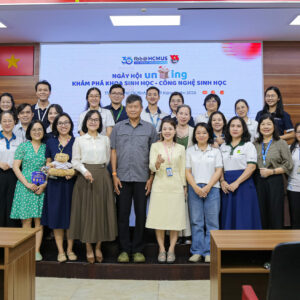

Từ ngày 24-26/2/2026, Trường Đại học Khoa học tự nhiên, ĐHQG-HCM tổ chức khóa học chuyên sâu về công nghệ bán dẫn do TS. Nguyễn Văn Sơn – Nghiên cứu gia chính tại IBM Albany Nanotech (Hoa Kỳ) trực tiếp giảng dạy. Khóa học quy tụ 50 giảng viên và học viên cao học, tập...
Tác giả: Phòng Thông Tin Truyền Thông (Thông Tin Truyền Thông Phòng)
Trường Đại học Khoa học tự nhiên, ĐHQG-HCM gặp mặt đầu xuân Bính Ngọ 2026, khởi động năm làm việc mới
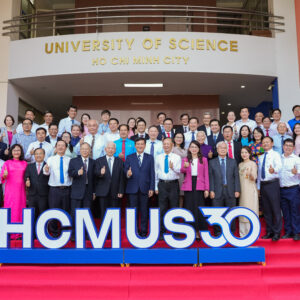
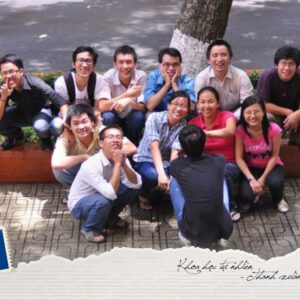
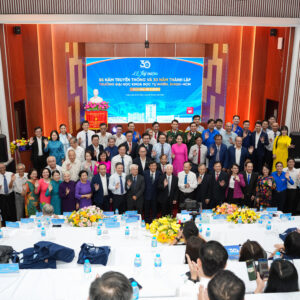
Trong không khí rộn ràng của những ngày đầu xuân Bính Ngọ 2026, sáng ngày 23/02, Trường Đại học Khoa học tự nhiên, ĐHQG-HCM đã tổ chức chương trình Gặp mặt đầu xuân với sự tham dự của Ban Giám hiệu cùng toàn thể viên chức, người lao động Nhà trường tại cơ sở Nguyễn...
Nữ tiến sĩ “đi đến đâu rinh giải tới đó”
Với nhiều giải thưởng uy tín trong lĩnh vực khoa học, mới đây, tiến sĩ tốt nghiệp từ Đại học Stanford Hà Thị Thanh Hương được công nhận và bổ nhiệm chức danh Phó giáo sư. Gương mặt của những giải thưởng Sau khi hoàn thành chương trình tiến sĩ tại Đại học Stanford (Mỹ),...
Identification of public neoantigens with broad HLA class I coverage as candidates for off-the-shelf cancer vaccine development in colorectal cancer
Abstract Introduction: Shared neoantigens derived from recurrent mutations represent promising targets for off-the-shelf (OTS) cancer immunotherapies; however, their clinical utility is often constrained by population-specific HLA diversity and variable immunogenicity. There remains a need for population-tailored neoantigen panels with broad HLA coverage and functional validation. Methods: We developed a colorectal cancer (CRC)–specific OTS neoantigen panel...
Enhanced nutrient removal and microbial stability in a hybrid membrane bioreactor driven by Chlorella sorokiniana-Bacteria synergism
Abstract Shrimp farming wastewater is a high-salinity and nutrient-rich effluent that contributes to eutrophication, disrupts aquatic ecosystems, and degrades natural habitats. In this study, a microalgae-based membrane bioreactor (A-MBR) integrating Chlorella sorokiniana with activated sludge was developed and evaluated for nutrient removal from synthetic shrimp farming wastewater under saline conditions. The performance of the A-MBR was systematically...
Mừng Xuân Bính Ngọ 2026
Supplying catalytically active sites on melem/g-C3N4 hybrid structures via loading Ni nanoparticles for highly efficient hydrogen evolution reaction
Abstract Graphitic carbon nitride (g-C3N4) has been widely used as a material for hydrogen evolution reaction (HER) due to its visible-light activity, low cost, and non-toxicity. However, a rapid recombination of photogenerated electron-hole pairs, poor electrical conductivity, and a low specific surface area of g-C3N4 have hindered its practical performance. Melem/g-C3N4 (abbreviate: MCN) is a newer structure...
Chemically and physically modified PVA/CA: High-performance sustainable material for membrane capacitive deionization
Abstract Membrane capacitive deionization (MCDI) has been investigated as a promising desalination technology, offering reduced operational voltage and enhanced electrode regeneration capability. Traditional materials used for ion exchange membranes rely on fluorinated polymers, which face drawbacks on fabricating processes and high cost. This study introduces a natural-based cellulose acetate membrane, with improvements by both chemical...
Innovation of ZnO nanorods by integrating with Ag nanoparticles on polyimide substrate for wearable photodetector applications
Abstract In the IoT era, wearable photodetectors play a crucial role in remote healthcare and environmental monitoring. Semiconductors are the most important component of these devices. Among them, ZnO is a potential candidate due to its high charge carrier mobility, mechanical stability, low cost, and non-toxicity. However, ZnO has a limited working range within the...
Human explanation for counterfactual process
Abstract Counterfactual explanations (CE) can make face classifiers more transparent, yet existing methods implicitly target a single attribute at a time, yield unnatural imagery, overly broad or off-target edits, and weak interpretability. We introduce a unified framework that (i) constrains edits with FacePart-based segmentation masks, (ii) performs localized blended latent diffusion on Stable Diffusion 2.1,...