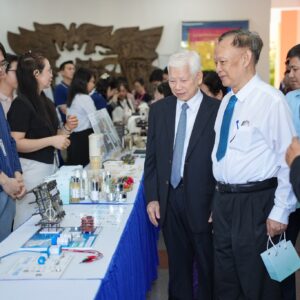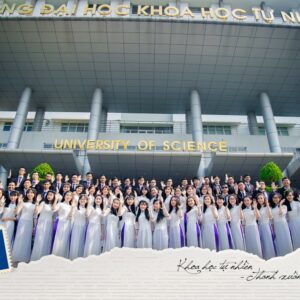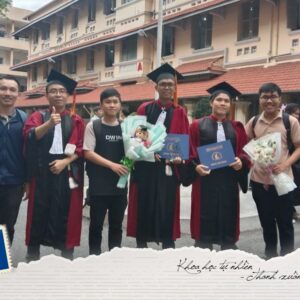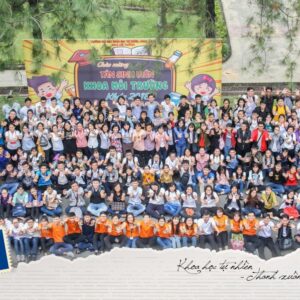

Với thành tích nổi bật trong học tập, nghiên cứu khoa học và cống hiến cho cộng đồng, sinh viên Võ Ngọc Minh Anh – Khoa Công nghệ Thông tin, Trường Đại học Khoa học tự nhiên, ĐHQG-HCM, đã được vinh danh tại lễ tuyên dương “Công dân trẻ tiêu biểu TP.HCM” năm 2025, do...
Danh mục: Story
Trở về kiến tạo tương lai công nghệ
Sau nhiều năm học tập, nghiên cứu và giảng dạy tại Hoa Kỳ, TS Trương Trung Kiên đã lựa chọn trở về Việt Nam, gắn bó với Trường đại học Khoa học tự nhiên – Đại học Quốc gia TP.HCM, mang theo khát vọng đóng góp cho khoa học công nghệ nước nhà và đào...
Nữ tiến sĩ Việt với những dự án pin ‘mật’ cùng Bộ Năng lượng Mỹ
Linh Lê, 29 tuổi, nghiên cứu sinh sau tiến sĩ tại Đại học Stanford, từng tham gia các dự án bảo mật của Bộ Năng lượng Mỹ nhằm tạo ra những loại pin sạc siêu nhanh, đặc biệt cho xe điện và điện thoại. Giữa tháng trước, Linh nhận giải ‘L’Oréal–UNESCO Vì sự phát triển...
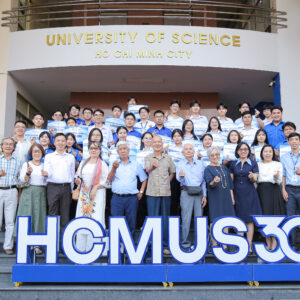
Biểu trưng kỷ niệm 30 năm Trường Đại học Khoa học tự nhiên, ĐHQG-HCM
LOGO HCMUS 30 Biểu trưng kỷ niệm 30 năm được hình thành từ sự kết hợp cách điệu của số 3 và số 0, hai con số liên kết với nhau bằng biểu tượng vô cực (∞), thể hiện hành trình phát triển không giới hạn, nơi tri thức và khát vọng được kế thừa...
PGS.TS Phạm Kim Ngọc: Thành quả ngọt ngào cho những ai đủ đam mê và kiên trì với khoa học
Gần 20 năm theo đuổi khoa học vật liệu, PGS.TS Phạm Kim Ngọc – Trưởng Bộ môn Vật liệu Nano và Màng mỏng, Khoa Khoa học và Công nghệ Vật liệu, Trường Đại học Khoa học tự nhiên, ĐHQG-HCM tin rằng quả ngọt sẽ dành cho những người đủ đam mê và kiên trì trên...
Selector-Free 16 × 16 CrOX/TiO2-Based Memristor Array for Synaptic Dynamics and LTP/ LTD Emulation: Experimental–Computational Correlation
Abstract This study presents a combined experimental–theoretical approach to understanding and optimizing CrOx-based self-rectifying memristor (SRM) for neuromorphic computing and provides a promising platform for selector-free, low-power crossbar arrays. By using a stencil-assisted DC sputtering technique, a 16 × 16 crossbar array is fabricated and exhibits reliable analog resistive switching, minimal sneak current (≈150 nA), and...
Mott–Schottky Au/Co3O4 Decorated on a Carbon Cloth Substrate as an Efficiently Bifunctional Electrocatalyst for Hydrogen and Oxygen Evolution Reactions
Abstract Catalytic materials for water splitting must possess pivotal characteristics such as cost-effectiveness, robust stability, and high performance toward the hydrogen evolution reaction (HER) and oxygen evolution reaction (OER). In this study, we utilized a designed Mott–Schottky material, Au/Co3O4, developed in conjunction with a low-cost and robust material: carbon cloth. The findings revealed that 30...
Cobalt-modified nitrogen-doped carbon nanotubes as bifunctional catalysts for one-pot synthesis of 2,5-diformylfuran from glucose
Graphical abstract In this work, nitrogen-doped carbon nanotubes bearing Brönsted acid sites and Lewis acid sites were successfully synthesized and applied for “one-pot” synthesis of 2,5-diformylfuran from glucose. Nguyen T.H.; Nguyen D.A.L.; Mai D.Q.; Le M.N.T.; Le D.D.; Phan H.B.; Tran P.H., https://doi.org/10.1016/j.jechem.2024.11.074
Macrophage-hitchhiked, effervescence-induced nanoemulsions for enhanced oral chemotherapy and immunotherapy: Impact on absorption route
Abstract Pancreatic ductal adenocarcinoma (PDAC) is a highly lethal cancer. Paclitaxel (PTX), typically administered intravenously (IV) as chemotherapy, shows promise for triggering immunogenic cell death (ICD) and may serve as a potential immunotherapy. This study introduces an oral PTX delivery method using an enteric-coated gelatin capsule containing capric acid oil and an effervescent agent, optionally with decylamine-conjugated β-glucans (DA-βGlus). Upon dissolving in the...
Multimodal missing data in healthcare: A comprehensive review and future directions
Abstract The rapid advancement in healthcare data collection technologies and the importance of using multimodal data for accurate diagnosis leads to a surge in multimodal data characterized by different types, structures, and missing values. Machine learning algorithms for predicting or analyzing usually demand the completeness of data. As a result, handling missing data has become a critical concern in the healthcare sector. This...