



Abstract
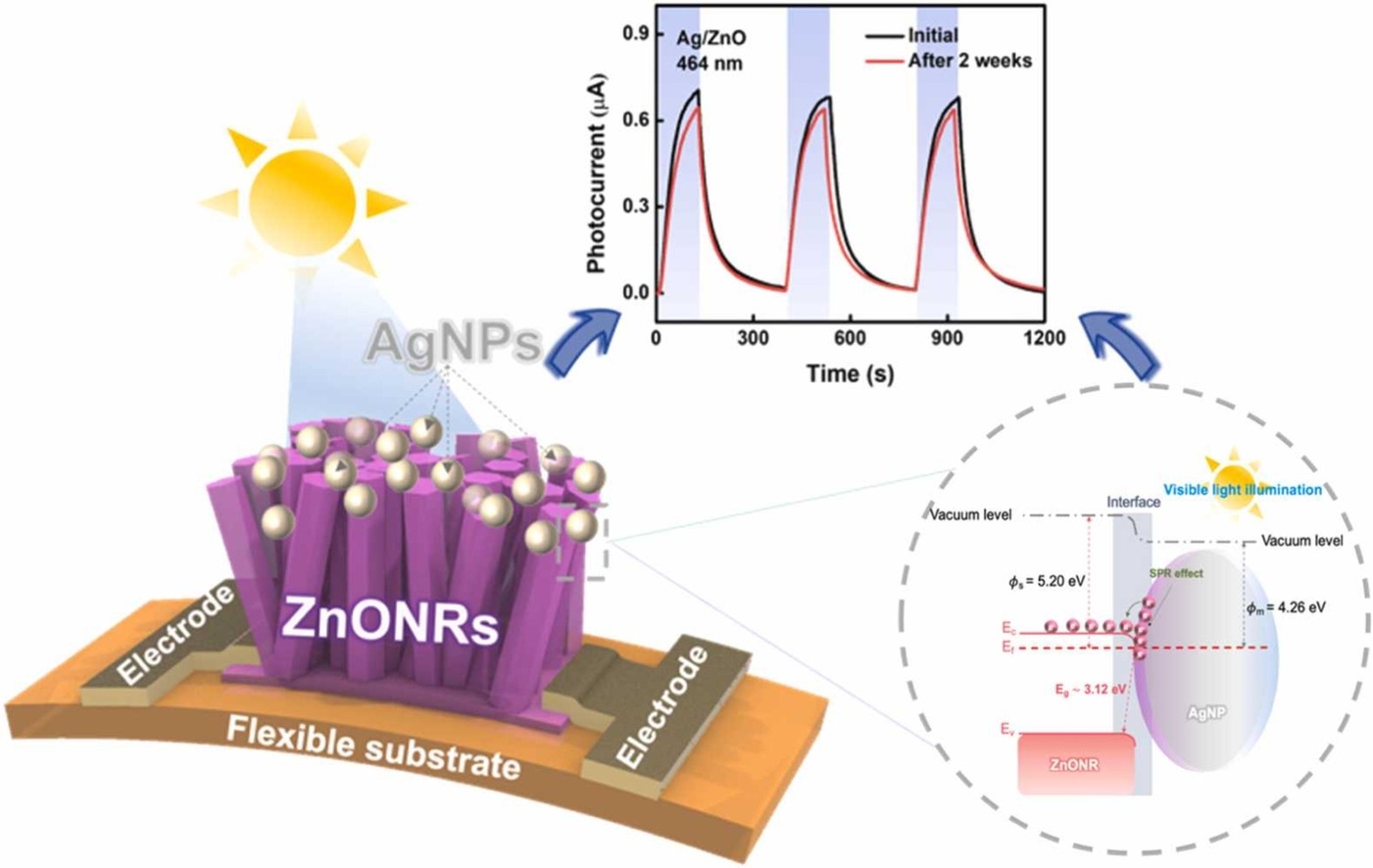
In the IoT era, wearable photodetectors play a crucial role in remote healthcare and environmental monitoring. Semiconductors are the most important component of these devices. Among them, ZnO is a potential candidate due to its high charge carrier mobility, mechanical stability, low cost, and non-toxicity. However, ZnO has a limited working range within the UV region. Here, the study introduces the development of an Ag/ZnO hybrid structure using an eco-friendly hydrothermal method for growing ZnO nanorods and producing Ag nanoparticles via green glucose reduction directly on a flexible substrate. When exposed to visible light (464 nm), the developed Ag/ZnO device (under 2 V bias) exhibits high responsivity and detectivity of 4.5 mA/W and 3.6 × 10⁹ Jones, respectively, along with response and recovery times are 40.8 s and 27.1 s; meanwhile, pristine ZnO devices show no response. To demonstrate the devices’ practical usability, (i) bending tests reveal their high flexibility, in which the responsivity remains 85 % after 1600 bending cycles, and (ii) a long-term test confirms the good workability after storing in air for 2 weeks. These outcomes indicate that our green method can pave the way for creating cost-effective materials for flexible photodetectors in wearable applications.
Graphical Abstract
Nguyen, B.G.M., Huynh, H.N.D., La, H.P.P., Le, T.D. and Dang, V.Q. (2026) Sensors and Actuators A: Physical, 402, p. 117601.