



Abstract
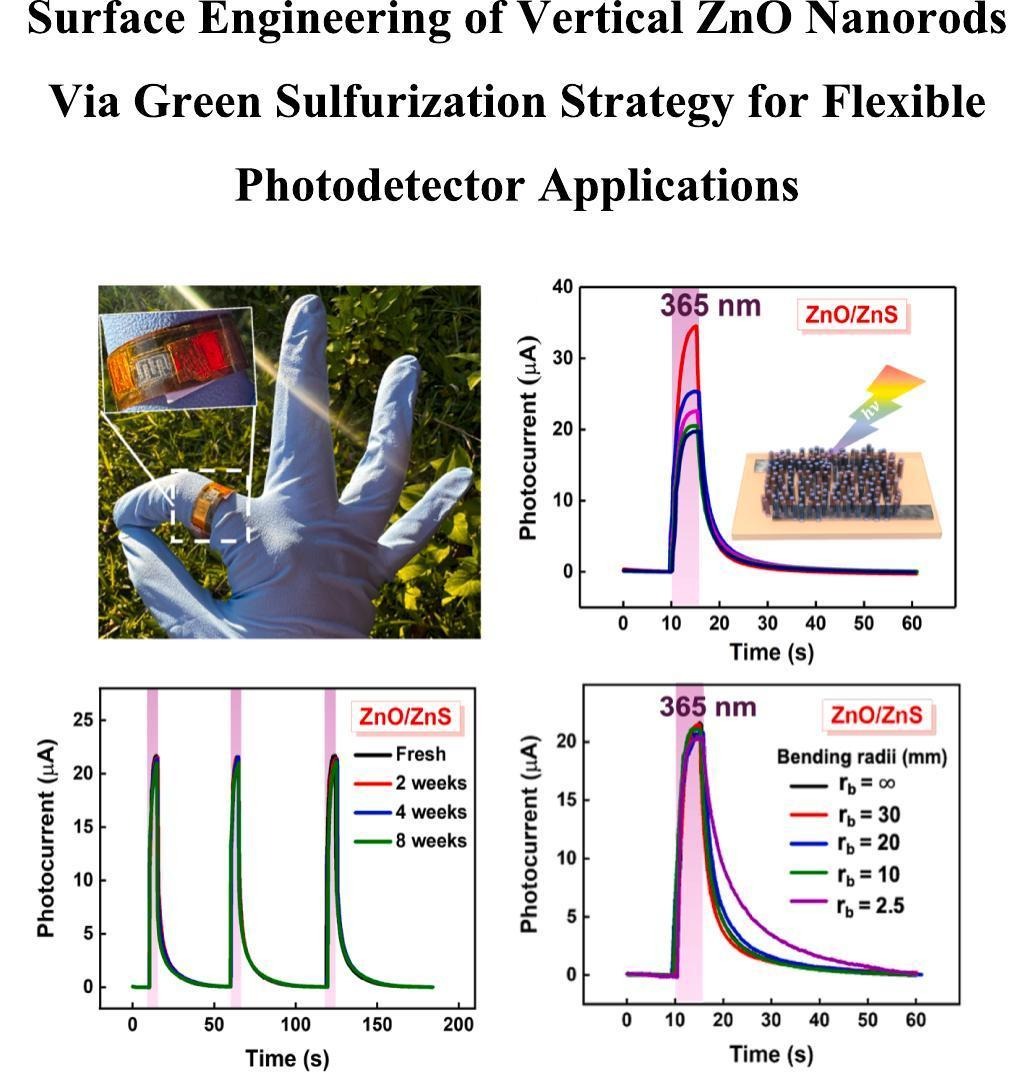
In the Internet of Things era, flexible photodetectors have received significant attention for applications in wearable electronics and human–machine interfaces. ZnO nanorods, known as a large bandgap semiconductor, is a promising candidate for flexible photodetectors; however, it still has some limitations for practical use, especially low response and humidity interference. Thus, to overcome these challenges, our study on surface engineering of ZnO nanorods via a sulfurization strategy to form ZnO/ZnS core/shell structure by using a low-cost, fast, and green route is proposed. Furthermore, sulfurized ZnO-based flexible photodetectors using laser-patterned carbon electrodes are developed. The effects of the sulfurization strategy on the sensing performance and humidity resistance of devices were investigated in detail. When tested under UV light of 365 nm, the sulfurized device exhibits a high responsivity and detectivity of 14.1 A/W and 9.1 × 10¹² Jones, respectively, which are 16-fold higher than those of the bare ZnO device. Additionally, the sulfurized device demonstrated remarkable stability in 95 % RH and high flexibility retaining 92 % of its responsivity after 1500 bending cycles. In general, with the results obtained from this study, we believe that our strategy opens a new pathway for developing low-cost flexible PDs for wearable and green applications.
Graphical abstract
Huynh, H.N.D., Nguyen, B.G.M., Tran, N.Q., Tran, C.K., Dang, V.Q., Sial, Q.A., Hoa, H.T.M., Tran, T.T.V. and Le, T.D. (2026) Applied Surface Science, 720(Part A), p. 165140.