



Abstract
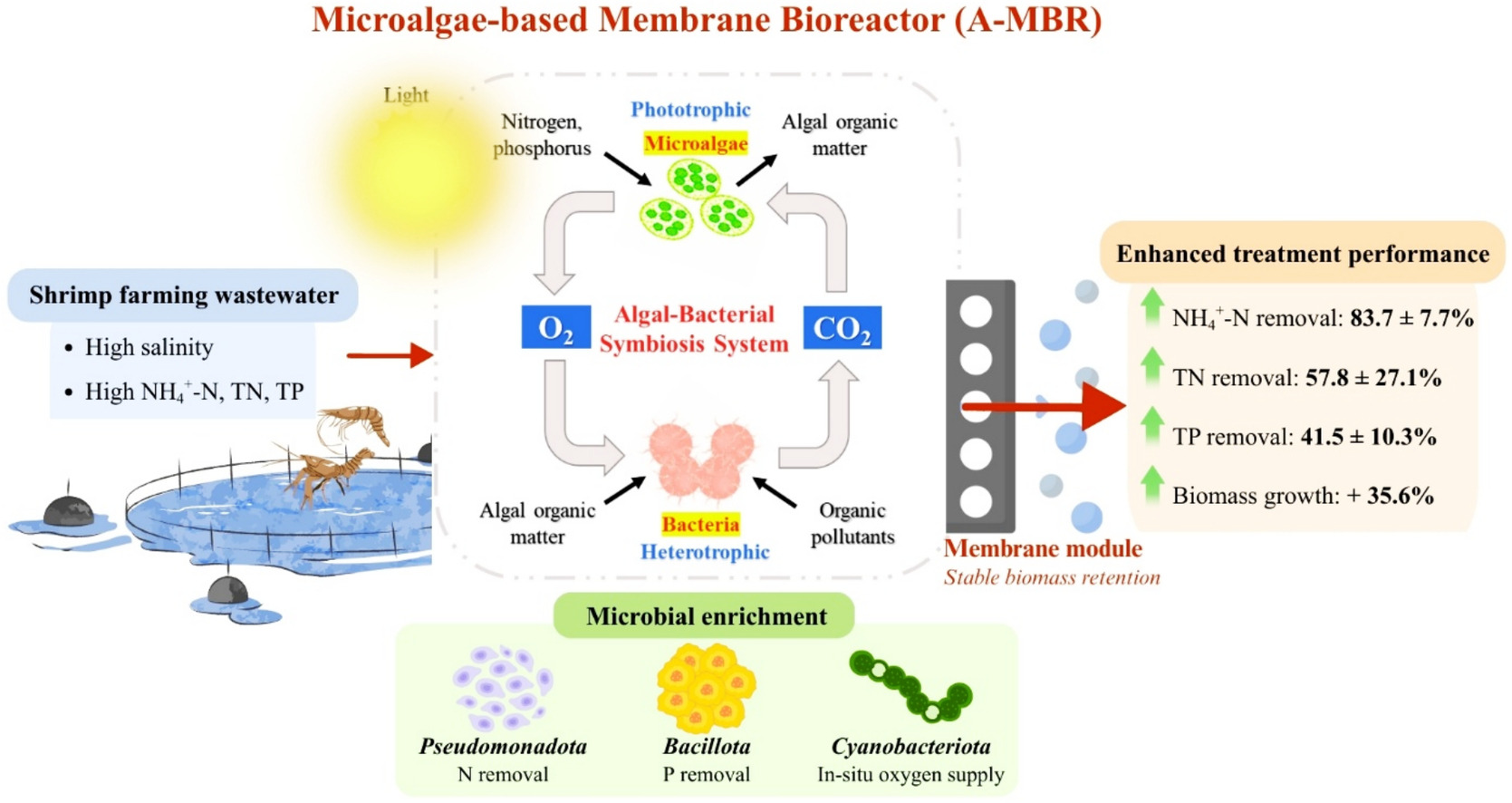
Shrimp farming wastewater is a high-salinity and nutrient-rich effluent that contributes to eutrophication, disrupts aquatic ecosystems, and degrades natural habitats. In this study, a microalgae-based membrane bioreactor (A-MBR) integrating Chlorella sorokiniana with activated sludge was developed and evaluated for nutrient removal from synthetic shrimp farming wastewater under saline conditions. The performance of the A-MBR was systematically compared with that of a conventional membrane bioreactor (C-MBR). The A-MBR achieved superior removal efficiencies of 83.7 ± 7.7% for ammonium (NH4+-N), 57.8 ± 27.1% for total nitrogen (TN), and 41.5 ± 10.3% for total phosphorus (TP), outperforming the C-MBR and indicating improved treatment performance and bioreactor stability under salinity stress. The enhanced performance was associated with synergistic algal-bacterial interactions, including photosynthetic oxygen production, direct nutrient assimilation by microalgae, and bacterial nitrification-denitrification processes, which collectively improved biological activity and system stability under saline conditions. High-throughput 16S rRNA gene sequencing further revealed increased bacterial community diversity and enrichment of functional taxa involved in nitrogen and phosphorus transformation. These findings provide mechanistic insights into algal-bacterial synergism within an MBR framework and highlight the A-MBR as an effective and sustainable strategy for nutrient removal from saline aquaculture wastewater.
Graphical abstract
Nguyen, T.-M.-P., Phan, N.N., Ngo, H.L., Nguyen, P.-T., Nguyen, H.-V., Tran, C.-S., Du, M.-L., Hatamoto, M., Watari, T. and Yamaguchi, T. (2026) Journal of Water Process Engineering, 84, p. 109748.